Back in the second year at Leeds, we had some choices about which courses we followed on our scheme. I’m not sure if Special Period was a compulsory or an elective, but it’s one I enjoyed immensely. The course was, I think, the only one we did that was defined not by genre or author but by periodicity. And the period chosen was quite closely circumscribed, covering the thirty-five years leading up to the end of the eighteenth century. So, at one end we had Walpole and the beginnings of the gothic novel, and at the other the first stirrings of the Romantics. The reading list was, as usual, comprehensive:
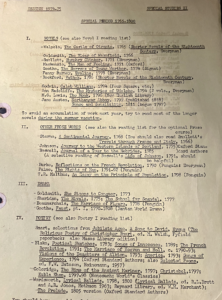
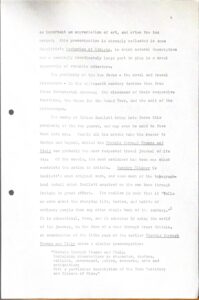
I read all the novels, and much of the poetry. The course complemented other courses on the novel, and to some extent on poetry, with several writers and texts featuring in more than one reading list. The Novel and Special Period courses were my introduction to the great writers of eighteenth century fiction: Defoe, Fielding, Richardson, Sterne, Smollett, Radcliffe. Our lecturer on Special Period was Frank Felsenstein, who back then was a relatively newly-fledged PhD, aged 30, with a thesis on Tobias Smollett, and who went on to have a distinguished career at Leeds and in America. More of that later. I don’t remember discussing the texts on this course in our weekly tutorials, where our tutor could range over material from any of the mainstream courses we were following. Special Period seemed very much to be Dr Felsenstein’s baby, and everything stemmed from his weekly one-hour lecture. The assessment for this course was different too. Shockingly, there was no exam, but instead we had to produce a dissertation — a long essay, really –of about 7500 words, which had to be in typewritten form. We were given some titles to choose from, and I, unwittingly, chose the title probably closest to our tutor’s interests, on the relationship between travel literature and the novel. Of course, I had no access to a typewriter, but the English department secretary, Audrey Stead, maintained a list of typists, and organised the process for us. I can’t remember how much I paid to have my modest effort typed – not very much, I’m sure, as I couldn’t have afforded much. A sample page from the carbon copy that I retained after submitting my piece:
This course, more than others, located the literature within the cultural landscape of the time, so we encountered our texts in the context of artistic, philosophical and political developments in this period of rapid change. The revival of interest in the gothic, which informed the novels of the time, the vogue for the picturesque in art, the French Revolution, the rise of Romanticism — all of these aspects and more made the course feel different to our other studies. Frank Felsenstein’s lectures were lively, erudite and engaging. In my case, I can see a direct connection between this course and my lifelong interest in the travel literature and art of the time, which I was able to use in my later career. In one of the periodic reviews of the BA course which I led, I proposed a module on The Grand Tour, which went on to be a very satisfying and well-received module for some years. My enthusiasm for the topic stemmed directly from my experience of this course in 1974-5.
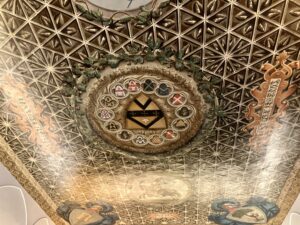
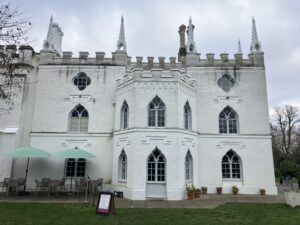
My dissertation centred on Smollett, Sterne and Radcliffe, but I enjoyed the wide range of other texts we encountered, from Walpole’s insane The Castle of Otranto to Lewis’s bloodthirsty The Monk via Blake’s visionary The Marriage of Heaven and Hell. It was a rich syllabus, and we immersed ourselves in it. I have felt its reverberations over the years. On my MA, I wrote about Lewis and Sterne. My Grand Tour module featured Smollett, Radcliffe and Sterne’s writings among others. I’ve just posted a piece on Substack about Smollett’s Humphry Clinker. Last month, I was able to visit the restored Strawberry Hill House, home of Horace Walpole, and wallow in its gloriously camp, over-the-top gothicity.
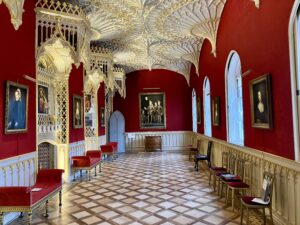
So Dr Felsenstein’s course had a big impact on me, and it’s great to note that he is still going strong, and still academically active at the age of 80. He still features on the Leeds website as a member of its Centre for Jewish Studies. His profile there gives details of his career, some of which is expanded upon in this description of the archive he has donated to Ball State University. I was pleased to see that he has included in his papers there his notes made as an undergraduate at Leeds. It’s not just me who hoards these things then!
 Touring through the eighteenth century by Dr Rob Spence is licensed under a Creative Commons Attribution-ShareAlike 4.0 International License.