The second year course for those of us on Scheme C was quite mainstream, but we still had to tackle the successor to Anglo-Saxon, which was a course in Middle English, excluding Chaucer. Our texts were Medieval English Lyrics by R.T. Davies, Piers Plowman, Sir Gawain and the Green Knight for poetry; Malory’s Morte d’Arthur and various mystical writings for prose; and for drama, Everyman and Medieval Miracle Plays, edited by A.C. Cawley, another Leeds man, appropriately in the Everyman edition. The texts were all new to us, of course, but somehow familiar. We’d all some knowledge of King Arthur, so Malory and Gawain were not completely unknown quantities.
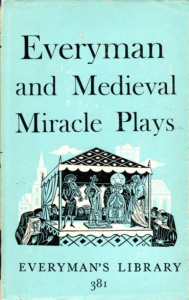
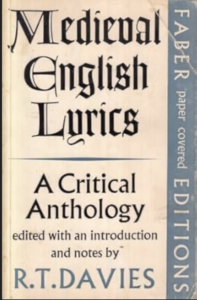
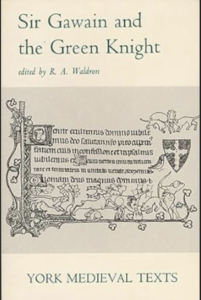
Having survived Anglo-Saxon, we felt confident about coping with this later version of English, and most of us had read some Chaucer anyway. Still, it was a challenge. The staff on the medieval side of the department were much more likely to issue handouts, and I have retained some of them, though irritatingly, I can’t find a course bibliography. The handouts were very useful, offering us a way into the intricacies of, for instance, the fourteenth century alliterative revival, as exemplified in Layamon’s Brut or Piers Plowman.
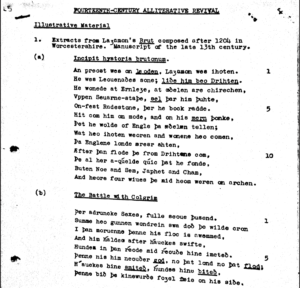 The diacritical marks and the ash, the thorn and the eth were somehow reproduced on the typewriter by, presumably, Audrey Stead, the English department secretary. We were lectured by a small group of staff, including, I think, Joyce Hill, but also another Hill. This was Dr Betty Hill, a stalwart of the department, whose contributions to Leeds Studies in English were frequent. She and Stanley Ellis edited the journal during my years at Leeds. My memory of Dr Hill is of a rather dour middle aged lady, with a no-nonsense manner. She was certainly learned, and we benefited from her expertise. I have to say, at a distance of fifty years, I was amused to read her own assessment of herself in her obituary, published in 2016 in the newsletter of St Hilda’s College, Oxford. As a graduate of St Hilda’s, her death was of course noted, but unusually, the obsequies had been prepared by herself. I was struck by two passages. Regarding her time at Leeds, she says “she found the ‘Leeds lot’ dull, noisily conceited and work-shy.” I’m sure her colleagues would disagree, as would I. The other, unintentionally hilarious boast suggests that “classes of up to a hundred and fifty appreciated her prodigious memory, her style and her wealth of fun, and often applauded her lectures.” Well, not at Leeds, they didn’t. We had a weekly lecture, followed by what was termed a seminar, because it consisted of maybe fifteen students, rather than the two or three that would constitute a tutorial. The other lecturer I remember on this course was Dr Peter Meredith, who specialised in drama, and gave the lectures on Everyman and the mystery plays. He was active in the Leeds Centre for Medieval Studies, and Leeds continues to be a major player in this scholarly field, hosting the annual International Medieval Congress, the largest academic conference in Britain. Dr Meredith is still with us, at the age of 93, according to his Wikipedia page. He was, I think, instrumental in the staging of the York Mystery Plays, which wound their way around the university in 1976.
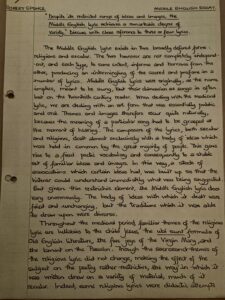
We were assessed by an end of year examination, of course, but we also had to write essays. I don’t seem to have preserved all my work on this course, but I do have an essay on the medieval lyric, to give you an idea of what we were writing on this course. It’s a piece on the Medieval English lyric, and I note that on this first page, I have managed to avoid following the instruction to make any close reference to a particular poem. I did do later on, I promise.
The world of medieval literature remains fascinating. For us, it was instructive to see the changes in the language from our Anglo-Saxon studies in the first year. Malory’s Morte d’Arthur was the most accessible of the texts we studied, but we managed to battle our way through all of them. There must have been an examination, as all assessment was by exam. I found some preparatory notes on the Second Shepherds’ Pageant from the Wakefield cycle and Piers Plowman, so I must have answered on those at least. Looking back over fifty years, I’m struck again by how much material we covered. The field of English Literature is a vast one, but we were very well acquainted with every quarter of it by the time we finished.
 Middling English by Dr Rob Spence is licensed under a Creative Commons Attribution-ShareAlike 4.0 International License.