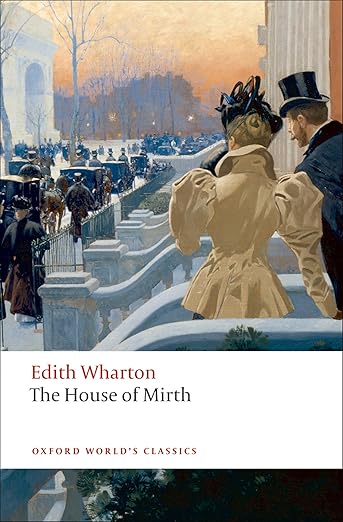
My knowledge of American literature is abysmal, especially if you exclude honorary Englishmen T.S. Eliot and Henry James. So I was happy to broaden my horizons by reading Edith Wharton’s 1906 novel, The House of Mirth. I was aware of Edith Wharton as a name, of course, and as a friend of Henry James, but had never read anything by her.
The House of Mirth announces its mood in its title, taken from Ecclesiates: “The heart of the wise is in the house of mourning; but the heart of fools is in the house of mirth.” And mirth is not the most common emotion evoked by a reading of this novel, though there are some darkly comic moments, to which I will return. The tragic history of Lily Bart is, above all, a clinical evisceration of the gilded lives of the idle rich in turn-of-the-century New York. Edith Wharton, herself a member of a fabulously wealthy New York family, pulls no punches in her exploration of the emptiness at the heart of these rich folks’ privileged existence.
Lily Bart, born into riches, but impoverished by her father’s financial ruin, is an orphan at a young age, reluctantly supported by her rich old Aunt Julia. Her life is an endless round of weekend parties and outings among New York’s smart set, amongst whom she must find a husband to keep her in the manner to which she has become accustomed.
Edith Wharton, doubtless writing from experience, presents occasionally a Jane Austen-like waspishness in her portrayal of the privileged central players in what becomes a psychodrama with Lily at the centre of a vortex of increasingly frantic activity. Here is Wharton, describing the nuptials of the obscenely wealthy Gwen Van Osburgh:
The Van Osburgh marriage was celebrated in the village church near the paternal estate on the Hudson. It was the “simple country wedding” to which guests are convoyed in special trains, and from which the hordes of the uninvited have to be fended off by the intervention of the police. While these sylvan rites were taking place, in a church packed with fashion and festooned with orchids, the representatives of the press were threading their way, note-book in hand, through the labyrinth of wedding presents, and the agent of a cinematograph syndicate was setting up his apparatus at the church door. It was the kind of scene in which Lily had often pictured herself as taking the principal part, and on this occasion the fact that she was once more merely a casual spectator, instead of the mystically veiled figure occupying the centre of attention, strengthened her resolve to assume the latter part before the year was over.
There are other passages where Wharton deploys sharp observation to satirise the habits and pre-occupations of this gilded set. Lily is acute enough to realise the paradox of her position. Using Austen-esque free indirect discourse, Wharton presents Lily’s analysis of her circle, noting the exception to the rule that Lawrence Selden represents:
Miss Bart was a keen reader of her own heart, and she saw that her sudden preoccupation with Selden was due to the fact that his presence shed a new light on her surroundings. Not that he was notably brilliant or exceptional; in his own profession he was surpassed by more than one man who had bored Lily through many a weary dinner. It was rather that he had preserved a certain social detachment, a happy air of viewing the show objectively, of having points of contact outside the great gilt cage in which they were all huddled for the mob to gape at. How alluring the world outside the cage appeared to Lily, as she heard its door clang on her! In reality, as she knew, the door never clanged: it stood always open; but most of the captives were like flies in a bottle, and having once flown in, could never regain their freedom. It was Selden’s distinction that he had never forgotten the way out.
Lily, despite her resolve, can never quite abandon all her scruples in the pursuit of wealth, and it’s this lack of a killer instinct that proves to be her downfall. The character who does personify the amorality of this world is Lily’s nemesis, Bertha Dorset, who ruthlessly exploits her position as the wife of the rich dullard George. She is a vain, manipulative woman, who poisons Lily’s prospects. As Lily says of her, she is protected simply by wealth: “She has a big house and an opera box, and it’s convenient to be on good terms with her.”
This is the world Lily inhabits, where friendships are brittle, and conditional on the maintenance of appearances based on conspicuous consumption. The possession of money enables any character flaw to be forgiven; the lack of it is social death. Lily, who has great beauty but little money, explains to her plain and sensible cousin Gerty how the dice are loaded against her, causing her to lie awake thinking of “dreadful things.”
“Dreadful things—what things?” asked Gerty, gently detaching her wrists from her friend’s feverish fingers.
“What things? Well, poverty, for one—and I don’t know any that’s more dreadful.” Lily turned away and sank with sudden weariness into the easy-chair near the tea-table. “You asked me just now if I could understand why Ned Silverton spent so much money. Of course I understand—he spends it on living with the rich. You think we live ON the rich, rather than with them: and so we do, in a sense—but it’s a privilege we have to pay for! We eat their dinners, and drink their wine, and smoke their cigarettes, and use their carriages and their opera-boxes and their private cars—yes, but there’s a tax to pay on every one of those luxuries. The man pays it by big tips to the servants, by playing cards beyond his means, by flowers and presents—and—and—lots of other things that cost; the girl pays it by tips and cards too—oh, yes, I’ve had to take up bridge again—and by going to the best dress-makers, and having just the right dress for every occasion, and always keeping herself fresh and exquisite and amusing!”
Lily does have chances to escape the gilt cage, but is reluctant to abandon the luxury lifestyle that goes with money. When Selden says that his idea of success is personal freedom, from all societal obligations, she is excited by the prospect, but cannot commit to it.
In the end, Lily is an object to the circle in which she is permitted to move. As Wharton puts it,
She had been fashioned to adorn and delight; to what other end does nature round the rose-leaf and paint the humming-bird’s breast? And was it her fault that the purely decorative mission is less easily and harmoniously fulfilled among social beings than in the world of nature? That it is apt to be hampered by material necessities or complicated by moral scruples?
One disappointing aspect of the novel is the casual anti-semitism that Wharton employs when referring to Simon Rosedale, the only Jewish character. He has a hold over some of the characters due to his bottomless resources, but virtually every reference to him is straightforward stereotyping. This kind of thing:
He was a plump rosy man of the blond Jewish type, with smart London clothes fitting him like upholstery, and small sidelong eyes which gave him the air of appraising people as if they were bric-a-brac.
Or this:
He had his race’s accuracy in the appraisal of values, and to be seen walking down the platform at the crowded afternoon hour in the company of Miss Lily Bart would have been money in his pocket, as he might himself have phrased it.
Or this:
Then he gave a short laugh, and drew out a gold cigarette-case, in which, with plump jewelled fingers, he groped for a gold-tipped cigarette.
Given the attitudes to Jews shown by, for example, TS Eliot, it’s hardly a surprise that Wharton goes for caricature rather than character in her portrayal of Rosedale. Still, it’s disappointing, considering the fine detail of her character portrayals elsewhere.
Edith Wharton’s narrative of Lily Bart’s downfall reminded me a little of the tragic arc of Thomas Hardy’s heroines. I was also reminded of Magdalen in Wilkie Collins’s No Name. Both women are thrown unexpectedly on their own resources, and need to find a way to support themselves. The difference between the two is that Magdalen is utterly relentless in her pursuit of her goals and will let nothing stand in her way, whereas Lily Bart is never quite able to commit herself to achieving the version of herself that she imagines.
Since money, and lots of it, is at the heart of the story, it’s instructive to learn something about the value of the transactions we read about in the novel. Lily, who is poor, but who has a generous allowance from her aunt, loses $300 in a single card game. As Martha Banta, the editor of the Oxford World’s Classics edition points out, in 1906 when the book was published, an apartment in New York could be rented for $35 to $50 a month. Later, Lily owes $9000, which must equate to hundreds of thousands in today’s money. According to the biography of Wharton on Wikipedia, her family name, Jones, was the origin of the phrase “keeping up with the Joneses” on account of their massive wealth. Wharton and her husband bought a home for $80000 in 1893. The Measuring Worth website estimates a purchase of that amount would be over $3 million today, or if quantified as wealth held, $30 million.
This novel, then, provides a compelling portrait of a tiny sliver of society at a certain point in time. The gilt of the gilded age seems as fake as the nauseous Trump decor of the Oval Office. The lives of these people may be materially rich, but morally impoverished.
This is the first review in my 50 Classics series. I have been a little slow off the mark, so I hope to gather pace on this project soon.
 Fifty Classics 1: The House of Mirth by Dr Rob Spence is licensed under a Creative Commons Attribution-ShareAlike 4.0 International License.
Leave a Reply