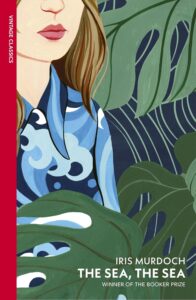
For over half a century, one way or another, I have been involved in reading, researching, teaching and writing about modern and contemporary literature. So, I’m somewhat embarrassed to admit that, until very recently, I had never read a novel by Iris Murdoch. I was aware of her, of course, and knew of her reputation, but somehow never got round to reading her. It’s a baffling omission, and now I have rectified my error, I am really looking forward to diving into her complete ouevre.
My entry into the Murdoch canon is her 1978 Booker Prize winner, The Sea The Sea. From what I can gather, the critical consensus is that, although the novel was generally praised on publication, it’s not considered to be Murdoch at the absolute top of her game. The Booker, it is suggested, was more a kind of “lifetime achievement” award than a prize for this particular book. Certainly, that’s what Sebastian Faulks suggests in his entertaining memoir Fires Which Burned Brightly, in which as a young reporter at the Telegraph, he gets the scoop about the award after meeting Martyn Goff, the administrator of the prize:
I managed to find out (probably from the indiscreet Martyn Goff himself) that Iris Murdoch was going to win the Booker Prize that year for The Sea, The Sea. I was amazed by this, as the book seemed shapeless and unedited, but perhaps they felt bad about having overlooked the superior Black Prince in its time.
I like Sebastian Faulks, and I’ll return to his memoir in a future post, but he’s wrong about this strange, disturbing, darkly funny novel. The shapelessness of which he complains is the product of the first-person narration of Murdoch’s protagonist, the retired Shakespearean actor and theatre director, Charles Arrowby. The novel consists of his often disconnected thoughts occasioned by his decision to leave London and go to live alone in a dilapidated lonely house somewhere on the coast. Exactly where this house is located is never revealed, but clues in the text suggest somewhere on the south or south-east coast. There’s something reminiscent of the Essex marshes in Murdoch’s description of the rather isolated, misty locale in which Arrowby spends his days swimming naked and consuming execrable meals, which he describes in enthusiastic detail.
Arrowby frequently muses on the nature of the text he is writing: is it a diary, a memoir, a novel? It’s all three, really, and his rather meta questioning of its status keeps the reader on their toes – how far do we trust this unreliable narrator, especially when he reminds us at intervals how unreliable he is? That question nags away at the reader as we navigate through the narrative, whose sections are given the heading “History” as if what we are reading has the stamp of authenticity, while all the time the authorial voice undercuts it. The initial “Prehistory” section gives us an overview of Arrowby’s life thus far, with gossipy anecdotes and reminiscences of messy love affairs, theatrical triumphs, and the first inklings of the obsessive personality which will dominate the central part of the narrative.
Having deliberately evoked the figure of Prospero as an inspiration for his solitary seaside life, Arrowby throws himself into his new milieu, but soon finds his plans thwarted by the unexpected sight of his teenage sweetheart, now a dowdy sixty year old. To compound his confusion, he is soon besieged by a group of his old theatrical friends and lovers, leading to the revival of fierce jealousies and passionate arguments. Arrowby chronicles the developing complex interactions as the situation gets ever more involved and markedly more alarming. All the while, the sea, and nature in general, provides an oppressively threatening backdrop to the human drama. Arrowby, egotistical, self-satisfied, pompous, delights in manipulating the people around him, as if he were directing a play. But the novel takes a darker turn when he realises it’s life, not theatre: “I had lost control of my life and of the lives with which I was meddling … I had awakened some sleeping demon, set going some deadly machine.”
The novel is set in the present day, meaning the mid 1970s here, so, since Murdoch was known to base some of her characters on real people, it’s fun to speculate on who she might have had in mind. Arrowby would be of the same generation, or slightly younger, than Donald Wolfit. Arrowby’s long time lover, Clement, was twenty years older than him, so maybe born around the turn of the century. Peggy Ashcroft doesn’t quite fit, and neither does Wendy Hiller. And of course, Murdoch did not necessarily base her characters on real people, so speculation is rather pointless, but fun nonetheless. Murdoch was, of course, a philosopher as well as a novelist. It’s no surprise, then, that her characters grapple, often amusingly, with some of the big issues of life. This applies especially to James, Charles’s cousin, whose mysterious background includes an immersion in Tibetan Buddhism.
The mixture of high seriousness and almost slapstick comedy scenes, all rendered through the lens of Arrowby’s vain, self-regarding perspective makes for a demanding but enjoyable and thought-provoking read. Readers looking for a neat narrative arc, with everything resolved – just don’t bother. On the other hand, if you want to read a novel with complex characters, unpredictable twists and turns, a smattering of the supernatural, and a messy conclusion, dive right in.
 Fifty Classics 2: The Sea, The Sea by Dr Rob Spence is licensed under a Creative Commons Attribution-ShareAlike 4.0 International License.
Leave a Reply