I am way behind on the account of life as an English undergraduate fifty years ago, so much so that it’s really fifty-two years ago now. Anyway, here’s the latest instalment. On Scheme C, we were obliged in our second year to take a course on Milton. The reading list was uncompromising. Here it is:
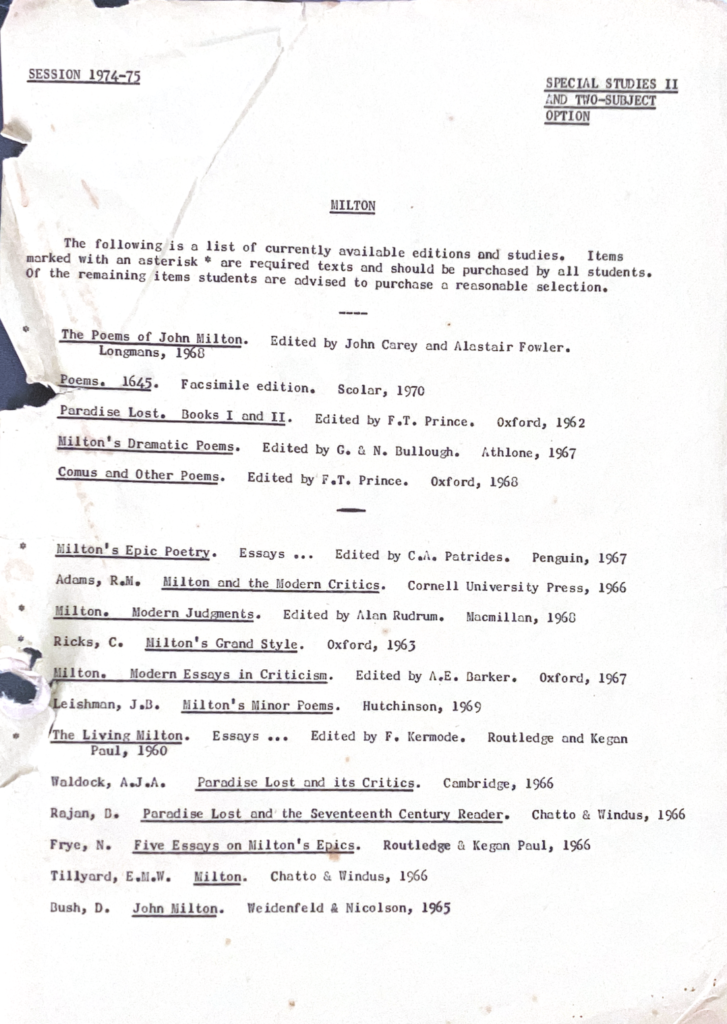
So, all the poems, plus a number of critical works as required texts, and a “reasonable selection” of others to be purchased. This seemed quite daunting to us, many of whom hadn’t read any Milton hitherto. I’d read “Lycidas” at A level, but that was the sum of my exposure to Milton. Our lecturer — and this was a lecture course, with no seminars or tutorials — was Robin Alston, who was a publisher as well as an academic. The second item on the reading list, and not a required purchase, was the facsimile edition of Milton’s poems, published by the small specialist publisher Scolar Press (prop. R. Alston). The Scolar Press, based in Menston, West Yorks., existed purely to publish facsimile editions of old, and sometimes obscure texts. Alston, who we realised early on was rather wealthier than the average lecturer, had founded the company in 1966, and it produced nearly 2000 facsimile volumes.
Robin Alston was an enthusiastic and lively lecturer, and he managed to spark our interest in Milton from the start. He was not the type to dumb down his subject matter, so it was important to be well-prepared for his lectures. We covered some of the shorter works in the first weeks of the course, including Comus and “Lycidas” and I see from my notes that it was week 8 when we came to Paradise Lost. The first line of my record of the week 8 lecture, which must have been Alston’s opening remark, was “There is no easy way of coming to terms with Paradise Lost.” Which seems to me as true now as it was in 1974, and indeed in 1667.
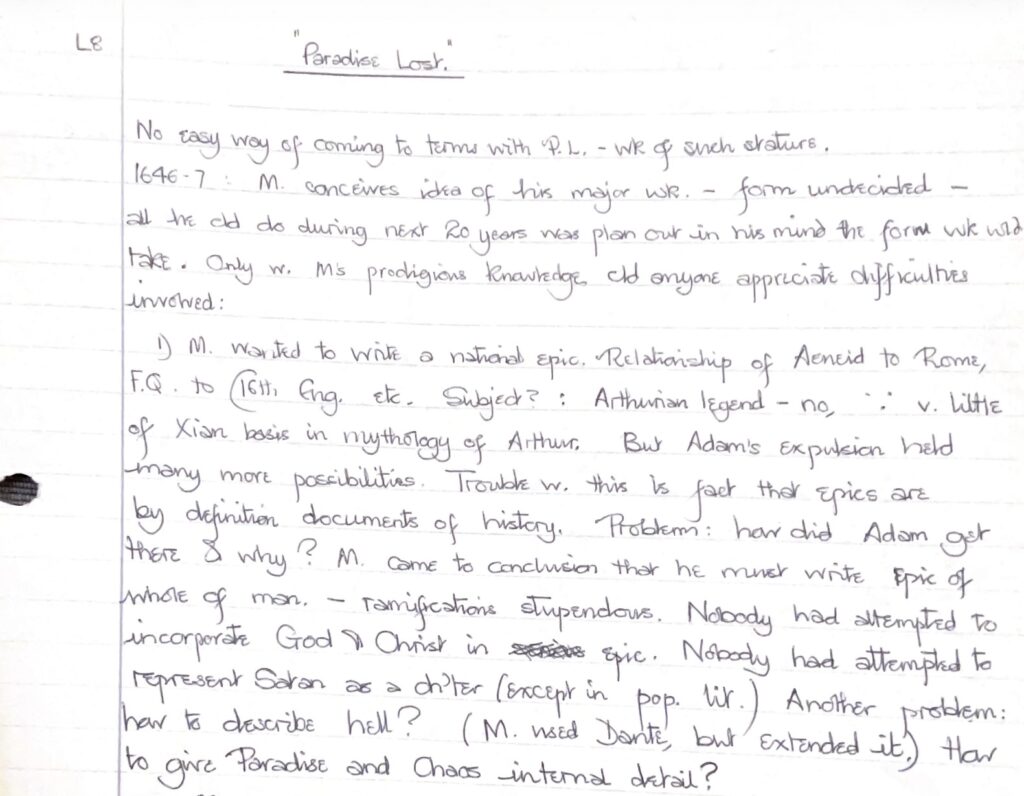
Paradise Lost formed the main spine of the course, and our detailed consideration of it stretched over the next ten lectures. Alston encouraged us to read it aloud, and we did: I spent a weekend with a group of fellow students taking it in turns to read it aloud from start to finish. I can’t say I’ve retained that much of it, though I do occasionally spot a submerged quotation and think -“that’s Milton.”
Another Alston suggestion, and I may not be remembering this absolutely correctly, was that we should try to put on a performance of Milton’s masque Comus at his home, which we divined was a stately pile somewhere in Ilkley. Nothing came of this, as far as I know. If any of my contemporaries remember anything about this, please let me know.
As was the case with all of the courses we studied, we were required to sit an examination on Milton, but at the end of the third year. Leeds, like most universities, preserved the idea of a degree in two parts: after the foundation of the first year, which was part I, the second and third year course together constituted part II. So we had no exams at the end of the second year, but many exams at the end of the degree. I have some revision notes on Paradise Lost in which I seem to have written pithy summaries of each of the twelve books, complete with select quotations.
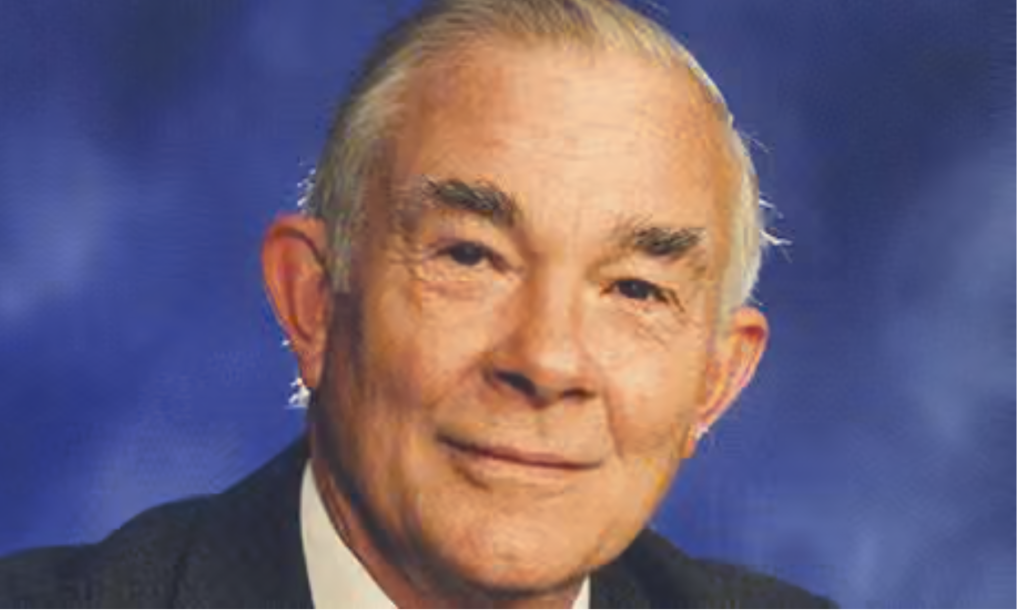
What we didn’t know about Robin Alston was what a remarkable man he was, as this obituary proves. According to the Times obituary, he actually invented a machine, the Prismascope, to enable him to produce the Scolar facsimiles. Neither did we realise that his background was in the West Indies. After leaving Leeds, he was a pioneer of what we now call the digital humanities, becoming a feted professor and receiving public honours in the shape of an OBE. I’m wondering what the subtext is behind the description of him in the Guardian obituary as “no saint.” Certainly in that account of his life, and in the one on Wikipedia, which bears a very close resemblance to the Guardian one, he is characterised as being rather prickly in his professional relationships, and maybe his personal ones too, since he married three times.
Intriguingly, I notice that the Guardian obituary, first published almost fifteen years ago, was revised as recently as last month “to correct some personal information.” That might refer to his third relationship: Wikipedia has him returning to his first wife after divorcing his second; The Times obituary has him marrying Conceição Neves da Silva Colella, whereas the Guardian says he “formed a relationship” with her.
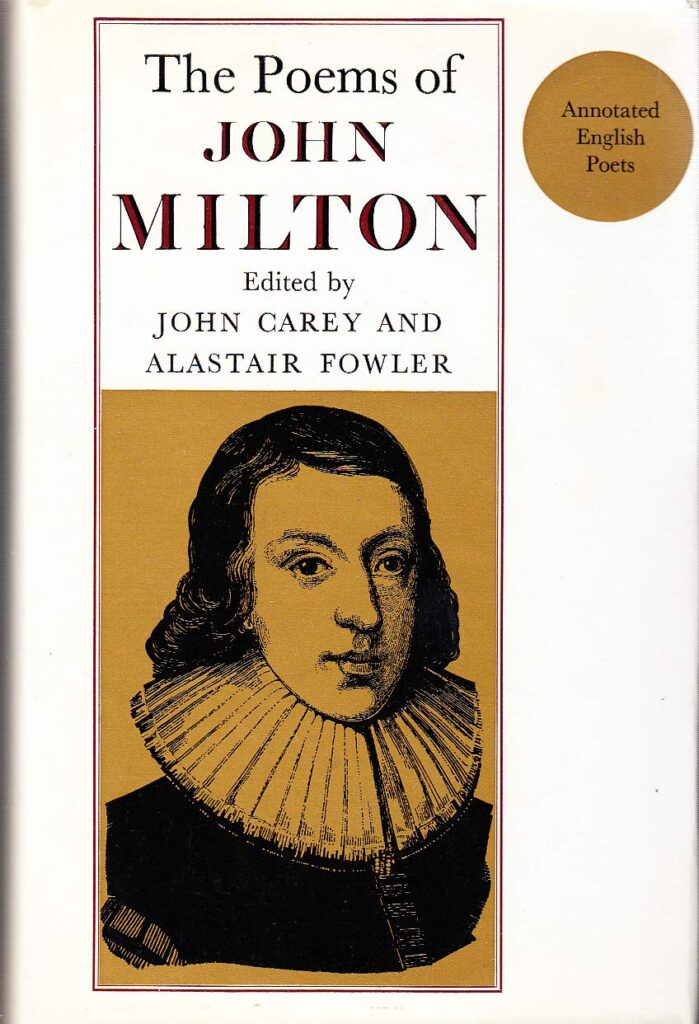
Whatever the circumstances of his personal life, I felt privileged to be in the hall when he delivered what can only be described, in that over-used word, as magisterial accounts of the works of Milton. My copy of the Carey and Fowler edition is long gone, but my respect for Milton is undiminished, largely thanks to Professor Robin Alston, OBE.
 Paradise Lost in Leeds by Dr Rob Spence is licensed under a Creative Commons Attribution-ShareAlike 4.0 International License.
Leave a Reply