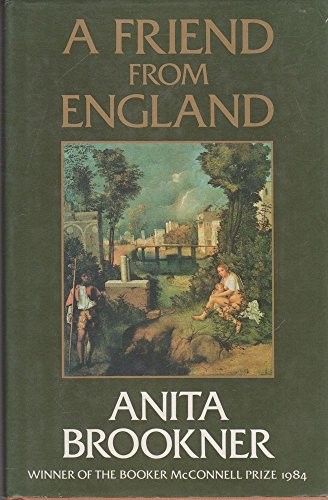
My previous post in this 50 Classics thread was about my first encounter with Iris Murdoch. This one is another first encounter, again with a Booker Prize winning woman author, of roughly the same vintage: Anita Brookner. The Booker was awarded for her best-known novel, Hotel du Lac, whereas A Friend From England did not universally please the critics.
My copy has been sitting on the shelf for decades. It’s a signed first edition, and I can’t remember where, or why, I acquired it. It was published in 1987, and there’s something very eighties about some of the narrative detail: high heels, power dressing and so on. But the focus of the story is Rachel, the first-person narrator, who lives a determinedly self-sufficient life, avoiding all emotional connections. It’s a bold move by Brookner to make her central character such a cold fish, but it makes for an intriguing narrative as we see everything from her perspective, while maybe having insights that she doesn’t. She is not an unreliable narrator as such, but we do question some of her ideas, and perhaps adopt a more sympathetic attitude to the other characters than she does.
Rachel, whose name we don’t learn until some way into the novel, is a single woman in her early thirties, who forms a friendship with Oscar and Dorrie Livingston. Oscar was her late father’s accountant, and now is hers. Oscar and Dorrie have a daughter, Heather, who is 27, and the centre of their world. They see Rachel as a kind of mentor to Heather, who is docile, and rather dull. Very early in the narrative, the Livingstons’ world changes when Oscar wins a large sum of money on the pools. This enables them to set Heather up with a boutique, and to live in opulent, if vulgar splendour. Brookner’s descriptions of clothes and decor are always pin-sharp. This is the Livingstons’ house:
The house -a substantial but essentially modest suburban villa – was furnished with voluptuous grandeur in approximations of various styles, predominantly those of several Louis, with late nineteenth- and early twentieth-century additions. Heavy coloured glass ashtrays of monstrous size and weight rested on inlaid marquetry tables of vaguely Pompadour associations. At dinner we drank champagne from ruby Bohemian glasses: the meat was carved at a Boulle-type sideboard. ‘Regency’ wallpaper of dark green and lighter green stripes was partially covered by gilt-framed landscapes of no style whatever.
The friendship continues, and Rachel soon adopts the role of a kind of honorary daughter, and companion to Heather. We find out very little about Rachel: she lives alone, her parents are both dead, and she has an unexplained fear of water. She frequently mentions her friends, but they never appear: the focus is relentlessly on the Livingstons, and the developments in their lives – or rather, Rachel’s perception of them.
At several junctures in the novel, Rachel appraises her own character in less than self-flattering terms. For example, she justifies her hard exterior as a protection against the wiles of a wicked world:
It seemed to me that I conducted my life on rather enlightened principles; that is to say, I imposed certain restraints on my feelings, kept a very open mind, rather despised those conventions that are supposed to bring security, and passed lightly on whenever I saw trouble coming. I had resolved at a very early stage never to be reduced to any form of emotional beggary, never to plead, never to impose guilt, and never to consider the world well lost for love. I think of myself as a plain dealer and am rather proud of the honesty of my transactions. After all, I have had to make my way in the world, and I could only do so by being clear-eyed and self-reliant.
As occurred quite often in this book, I noticed a couple of sly half-references in there: The Plain Dealer, by Wycherley, and All for Love, or The World Well Lost by Dryden, are both Restoration dramas, though neither, it seems to me, have much to do with Rachel and her world, which is a rather claustrophobic one: she works in a bookshop which she part-owns, and lives in a dingy flat above it. Despite her claim to have many friends and many affairs, we never encounter anyone beyond the closed circle of the Livingston family or Rachel’s two co-workers in the shop.
It’s difficult to say much more about this novel without giving too much of the plot away. I always think that it’s the duty of the reviewer to convey the flavour, or essence, of a book without revealing too much of the contents. On that topic, if you read the full blurb on the original hardback edition, you will be told pretty much the entire narrative, including an event that happens in literally the last few pages. This seems like a book version of those film trailers where the viewer (or at least this viewer) ends up thinking “well, there’s no point in watching that, now that I know the entire plot.”
I can, however, give a bit more of the eighties vibe, which is often connected in the novel with Rachel’s ideas of feminism. This passage, in which she imagines the lives of “liberated” women, who maybe rather secretly regret their liberation, is typical:
These are the ones who would secretly have been happier sitting at home listening to Woman’s Hour, but instead are to be found on the city streets early in the morning, tapping their way along the pavement in the sort of high-heeled shoes that are supposed to go with attainment, on their way to another day with the computer, or the Stock Exchange prices, or an important presentation, or a client to be exhaustively entertained. And after a day of this they get to meet their friends in a wine bar, where, over a bottle of Frascati, they decide where to go for the evening.
Their talk resembles the after-hours conversation of men. ‘What a day I’ve had!’ they cry to each other. I’m exhausted! You have no idea how the market is behaving at the moment. I’ve had New York on the line all day.’ Bravely they will decide to eat out, although waiters still dislike women diners on their own: they are thought to be a dubious advertisement, spreading the contagion of bad luck around them, not qualifying for the full treatment. Waiters also dislike the plastic swathe of dry cleaning left in the cloakroom, but this has had to be picked up in the lunch hour, otherwise there can be no power dressing for the following day.
This is not a lengthy novel – 200 pages in my edition – but it creates a lasting impression. As was the case with Murdoch’s The Sea, The Sea, this narrative does not end neatly, and many questions remain unanswered. Not least among those questions is the significance of the painting which adorns the dust-jacket: Giorgione’s “The Tempest.” It is, eventually, mentioned in the novel, but its role remains unclear, at least to this reader. The painting has puzzled art critics for centuries. It shows a half-naked woman suckling a child, while opposite her a soldier stands looking into the distance. In the background, lightning strikes, presaging the storm which gives the painting its title. It was Byron’s favourite painting, apparently, and maybe one of Brookner’s too: in her other persona, she was a Professor of Fine Arts at Cambridge.
I can see why this novel did not completely win over the critics, but its cool, elegant prose, the precision of its descriptions, and the deft characterisation all combine to make this a success in my eyes. It certainly hasn’t put me off reading Brookner, so I will doubtless return to her work in future.
 Fifty Classics 3: A Friend From England by Dr Rob Spence is licensed under a Creative Commons Attribution-ShareAlike 4.0 International License.
Leave a Reply