All of the material I have for my second year at Leeds has now been covered in previous posts. There was a course on the History of Criticism, about which I remember little, except that we complained because we couldn’t hear the lecturer – no microphones in those days. So we move on now to the final year array of courses, and I’ll start with the Novel. After covering the eighteenth-century rise of the novel in the second year, we were then immersed in some of the great nineteenth- and twentieth-century works for this course. Our reading list, as you see, ended in 1927, so it was hardly cutting edge, but it gave us a solid grounding in the way the novel developed over roughly a hundred years.
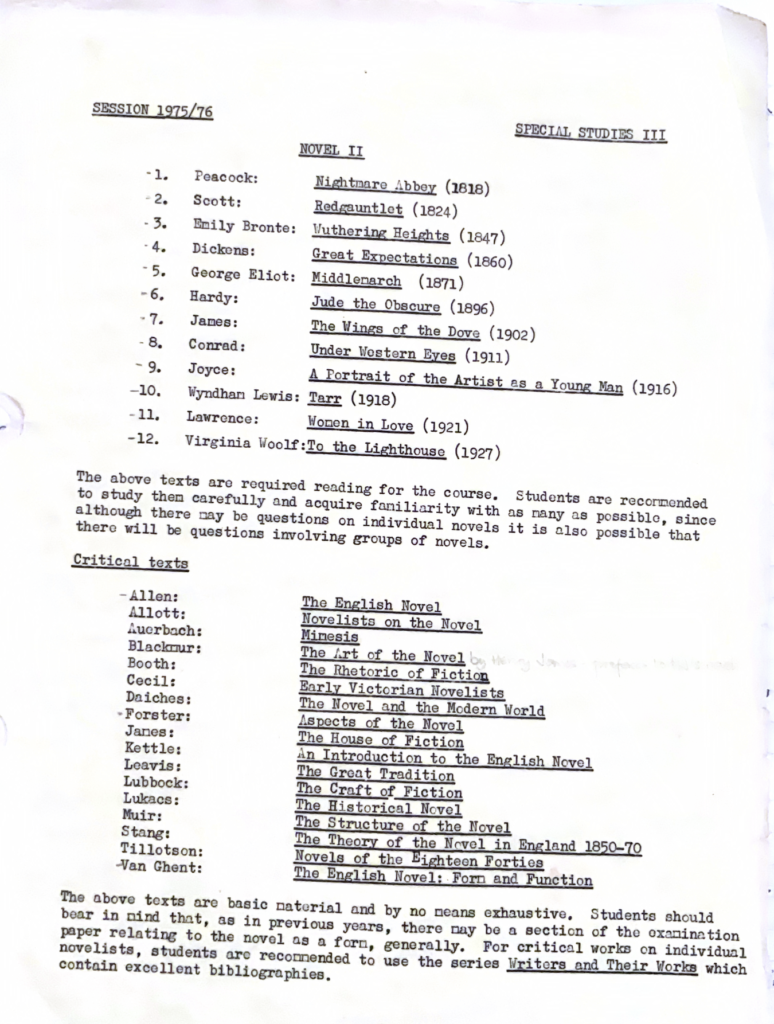
I think, though my memory may be hazy on this, that in the third year, some of our courses were one term, rather than lasting all year as previously. The Novel course was one of these, so it was more like a modern Lit module, though, as you can see, we had twelve primary texts, including massive Victorian tomes such as Middlemarch and Great Expectations to get through in one term. Henry James’s The Wings of the Dove was not exactly light reading either – and we had a separate course on James, which I will post about in future. I note now, fifty years after the event, that only three of our authors were women, distinguished by having their first names printed also, even when their name was a masculine pseudonym. The only male writer apparently granted a first name was Wyndham Lewis (though of course his actual first name was Percy.)
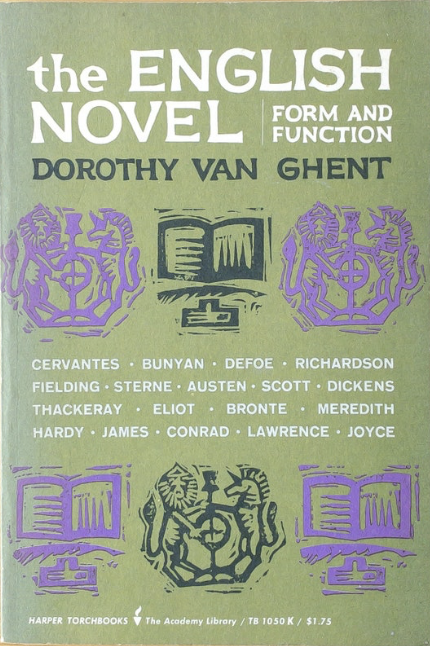
The list of critical texts was instructive: none of them were about a particular author – that was up to us to discover – but all were well-established overviews of fiction, often rather lofty (Mimesis) or with a particular agenda (Kettle). The volume that quickly became most desired as the one to consult was Dorothy Van Ghent’s The English Novel: Form and Function. This was a relatively recent publication (1953) and offered penetrating accounts of the work of several of our novelists. I remember it in this edition, which was much sought after in the Brotherton and in the English department library.
This was a weekly lecture course, and some of the texts would also be considered by our tutor in the weekly tutorial. Our lecturer was John Younger, a remarkable man for all sorts of reasons, but chiefly because he was blind. He would arrive in the lecture theatre with his guide dog, and deliver a perfectly composed and entertaining lecture on that week’s text. What we didn’t know was anything about his background. I found this out much later, after meeting his friend and colleague Alistair Stead, my tutor in the first and second years. Alistair wrote the obituary that appeared on the Leeds website when John Younger died in 2015, aged 85. In it, he recounts John Younger’s background and his role in the English department at Leeds:
John had been a talented artist, studying at the Royal College of Art and teaching art in several institutions, latterly in the Halifax College of Art when, in 1967, illness related to his diabetes resulted in the loss of his sight. With impressive determination, and the crucial support of his indomitable wife Maureen, he applied to the University of Leeds. Accepted as student in the School of English, he was awarded a First Class Honours degree in 1970 and his MA in 1972.
So, when he was lecturing to us, it was only a few years after his graduation, though of course he had been involved in teaching art for many years beforehand. We were in awe of his sang-froid and his ready wit, which informed both his lectures and his tutorials. I was in his group, and remember tutorials with four of us gathered around an office table, under which the guide-dog slept peacefully. Alistair Stead’s obituary continues:
As a notably humane, enthusiastic and inspiring tutor and supervisor, he was almost as popular as his guide dog Orla. He was always strikingly well-turned out and possessed an extraordinary memory for the visual details of so many paintings and films which he had enjoyed before he went blind. His teaching was informed by his wide range of intellectual and cultural interests, and he offered challenging and very successful options on subjects close to his heart, such as the literature of the First World War and the fiction of the 1930s.
That’s how I remember him. We were astonished at the scope of his memory. He could quote and summon up references, obviously without recourse to notes, and relate the literature to the art of its time, making his perspective a very original one.
I suspect the art / literature connection was behind his choice of Wyndham Lewis’s Tarr for the novel course. To my shame, I didn’t think I had even heard of Lewis until I saw his name on the reading list. I found the Calder and Boyars edition of Tarr, in the much-missed Willshaw’s bookshop in Manchester. I remember it had its pre-decimal price on – 10/6 – so I was charged 52½ pence for this volume:
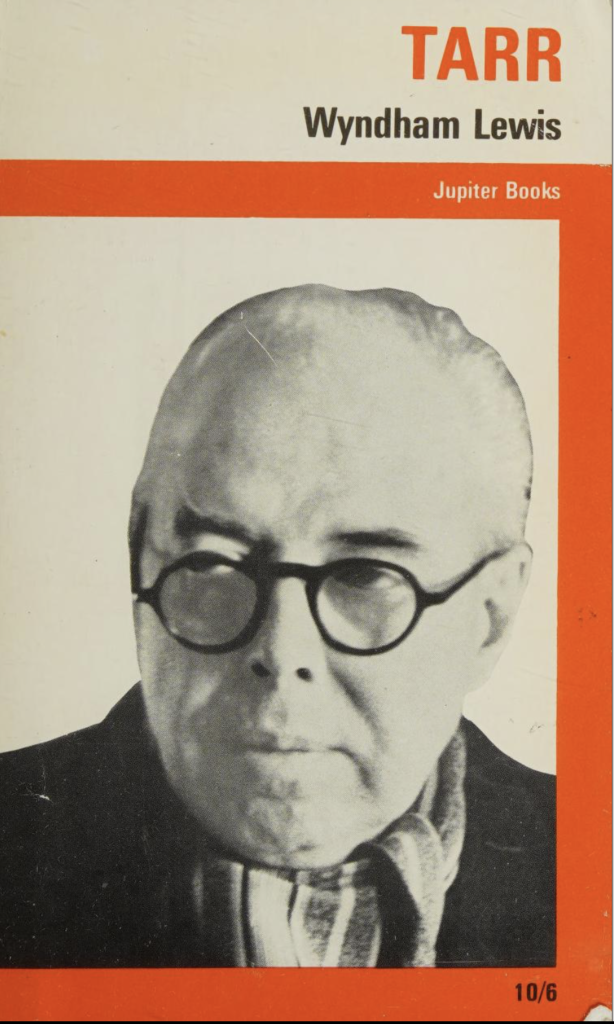
If you don’t know Tarr – and you really should – it concerns the lives and loves of artists in Paris in the early years of the century. Lewis had lived in this bohemian milieu, and indeed the character of Tarr is, as Lewis said, “a caricatural self-portrait of sorts.” Of all the novels on the reading list, this one intrigued me the most, mainly because, I think, it seemed an outrider, slightly out of place in a line of solidly canonical texts. I can’t remember if I wrote any essays on Tarr, though I must have written about it in the exam.
If you were a student on any of my Modernist Literature modules, you may well have come across Tarr. I specified it as a set text on many occasions, and John Younger’s Novel course in 1975 is the reason why. In my modest list of publications, there are a few pieces on Wyndham Lewis, whose work, both artistic and literary, has given me much pleasure over the years. So, rather like Frank Felsenstein’s Special Period course, this course gave me not just a solid grounding in the subject, but a lasting lifelong interest.
 Starting the final lap by Dr Rob Spence is licensed under a Creative Commons Attribution-ShareAlike 4.0 International License.
Leave a Reply