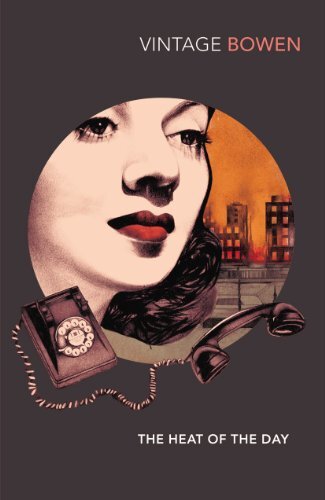
Completely by chance, and largely contingent on what was immediately available on my shelves, my first four reads for the Fifty Classics project have been women writers of the twentieth century, and each has been my first encounter with their work. The latest in the sequence is Elizabeth Bowen, and her 1948 novel The Heat of the Day. Actually, it’s not quite true to say that this is my first Bowen. I used a short story of hers, “Mysterious Kôr” when teaching mid-century literature, and that short story is, it turns out, a useful companion piece to The Heat of the Day.
The short story begins with a portrait of London during the Blitz:
Full moonlight drenched the city and searched it; there was not a niche left to stand in. The effect was remorseless: London looked like the moon’s capital—shallow, cratered, extinct. It was late, but not yet midnight; now the buses had stopped the polished roads and streets in this region sent for minutes together a ghostly unbroken reflection up. The soaring new flats and the crouching old shops and houses looked equally brittle under the moon, which blazed in windows that looked its way. The futility of the black-out became laughable: from the sky, presumably, you could see every slate in the roofs, every whited kerb, every contour of the naked winter flowerbeds in the park; and the lake, with its shining twists and tree-darkened islands would be a landmark for miles, yes, miles, overhead.
However, the sky, in whose glassiness floated no clouds but only opaque balloons, remained glassy-silent. The Germans no longer came by the full moon. Something more immaterial seemed to threaten, and to be keeping people at home. This day between days, this extra tax, was perhaps more than senses and nerves could bear. People stayed indoors with a fervour that could be felt: the buildings strained with battened-down human life, but not a beam, not a voice, not a note from a radio escaped. Now and then under streets and buildings the earth rumbled: the Underground sounded loudest at this time.
This febrile, uncertain, rather surreal atmosphere is replicated in the novel. Set very precisely in the streets of Marylebone mainly during 1942, the story touches on themes of love, family and treachery in the lives of a varied group of Londoners, principally Stella and Robert, lovers of two years’ standing, who snatch their time together against the constant backdrop of air raids and emergencies. Stella’s husband died very shortly after their divorce, leaving her to bring up Roderick, who is now conscripted. Robert works for a government department, and is invalided out of army service following a leg injury sustained at Dunkirk. At the funeral of Stella’s distant Irish cousin, she is approached by Harrison, who insinuates himself into her life, claiming that Robert is betraying the country, and suggesting that Stella might help him by succumbing to Harrison, presumably a spy of some sort.
The novel revolves mainly around the moral dilemma Stella faces, with a subplot involving a working class girl, Louie, whom Harrison has encountered at an open-air concert in Regent’s Park. The two storylines barely intersect, but when they do, it provides a significant moment in the plot. What struck me most about the novel was the intensity of the narrative, which alternates between descriptions of the city under bombardment and the fragmented, agitated conversations of the principal characters. An interlude where Stella visits the Irish house left to her son by her cousin provides an escape from the claustrophobic milieu of wartime London, and it’s not difficult to see Ireland (Bowen always refers to it as “Eire”) as a kind of idyll compared to the stringencies of London wartime life.
Like the London of “Mysterious Kôr”, Stella’s world here is a place of ghostly presences. Bowen certainly immerses the reader in the all-pervading uneasiness engendered by the condition of war. This passage demonstrates the eeriness of her evocation of place:
Most of all the dead, from mortuaries, from under cataracts of rubble, made their anonymous presence – not as today’s dead but as yesterday’s living – felt through London. Uncounted, they continued to move in shoals through the city day, pervading everything to be seen or heard or felt with their torn-off senses, drawing on this tomorrow they had expected – for death cannot be so sudden as all that. Absent from the routine which had been life, they stamped upon that routine their absence – not knowing who the dead were you could not know which might be the staircase somebody for the first time was not mounting this morning, or at which street corner the newsvendor missed a face, or which trains and buses in the homegoing rush were this evening lighter by at least one passenger.
These unknown dead reproached those left living not by their own death, which might any night be shared, but by their unknownness, which could not be mended now. Who had the right to mourn them, not having cared that they had lived ? So, among the crowds still eating, drinking working, travelling, halting, there began to be an instinctive movement to break down indifference while there was still time. The wall between the living and the dead thinned. In that September transparency people became transparent, only to be located by the just darker flicker of their hearts. Strangers saying ‘Good night, good luck’ to each other at street corners, as the sky first blanched then faded with evening, each hoped not to die that night, still more not to die unknown.
The narrative is, ultimately, I suppose, about wartime espionage, but there’s no Eric Ambler or Graham Greene feel, no dramatic action. Just the relentless, dogged momentum of the characters, particularly Stella, who just have to get on with their lives under intolerable pressure.
It’s an intense, but rewarding read, especially perceptive on the incidental and often minuscule changes of perspective that the mind goes through during a conversation. Bowen’s descriptions are little masterpieces of detail. Here’s a tiny moment where Stella and Robert are having dinner together in a restaurant, talking about Roderick’s inheritance of his cousin’s house:
‘Roderick would like it,’ she reflected, with an elbow on the table, supporting her temple on her hand, obliquely following with her eyes a scroll in the damask pattern of the cloth.
It’s this precision of the image conveyed that impressed me about Bowen’s writing. I think most writers would have just gone with the dialogue, and not described so precisely her exact posture, and the way her eyes are looking at the pattern on the tablecloth. The book is full of moments like this, where the actions of the characters are rendered in forensic detail. It means the book is quite slow-paced, but it does have a mesmerising effect on the reader.
Don’t read this for an action-packed account of London in wartime. Do read it for an exquisitely painted account of lives under pressure in desperate circumstances.
 Fifty Classics 4: The Heat of the Day by Dr Rob Spence is licensed under a Creative Commons Attribution-ShareAlike 4.0 International License.
Leave a Reply