Probably the most disturbing scene in Shakespeare occurs in Act 3 of King Lear, when Gloucester, duped by his bastard son Edmund, is delivered into the hands of Cornwall, who calls him a traitor. Cornwall plucks out one of Gloucester’s eyes as punishment, and then, encouraged by Regan, he takes the other. “Out, vile jelly!” he says, “where is thy lustre now?” It’s somehow more shocking than if Cornwall had attacked any other part of Gloucester’s body. And of course, the literal destruction of sight adds to the motif of metaphorical seeing and blindness that is prominent in the play. Lear is blind to his wicked daughters’ schemes, and to his good daughter’s faithfulness. Gloucester, too, fails to see through Edmund’s machinations. It’s a standard metaphor, but in Shakespeare’s hands, it develops and illuminates the tragic arc of the play.
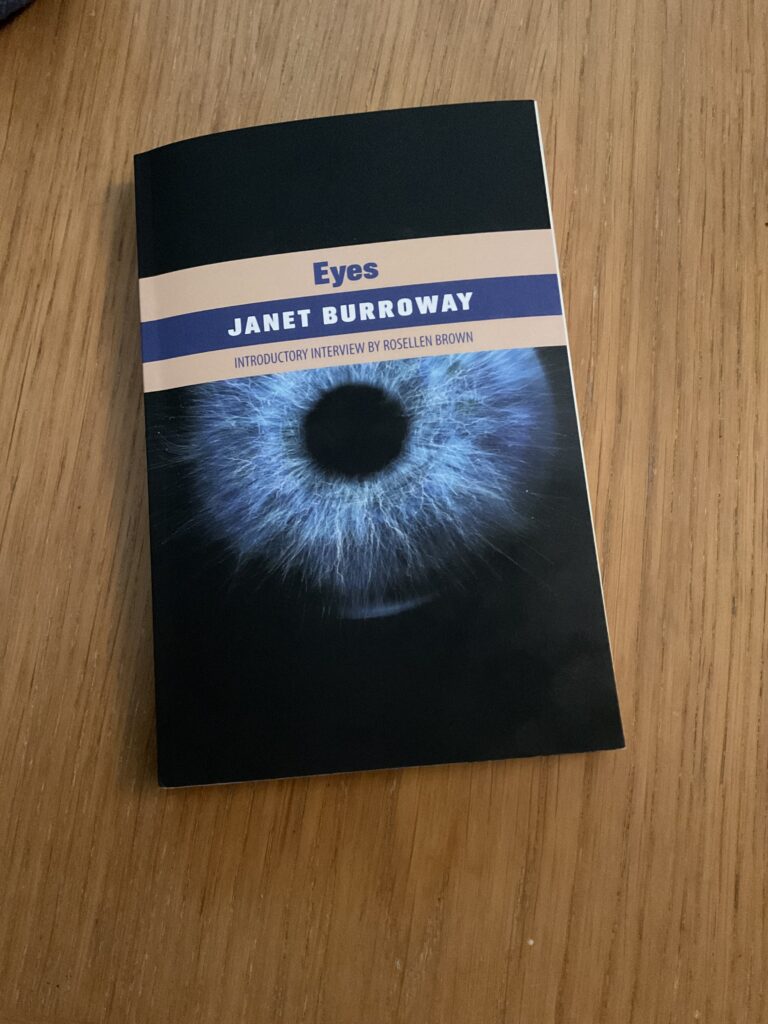
Janet Burroway’s novel Eyes, first published in 1966, announces in its title that it will foreground the organ of sight, and, by implication, the familiar metaphor that equates sight with perception and understanding. The setting is an unnamed city in one of the southern states of America. Burroway lived for a time in New Orleans, and this place has that kind of feel. The action takes place over a matter of hours, from noon on one day until noon the next, and concerns the lives of a small group of people: Angus Rugg, a middle-aged eye surgeon; his wife Maeve, unexpectedly pregnant with their second child; Hilary Rugg, their son, a cub reporter on the local newspaper; and Geraldine Spatch, called Jadeen, a supply teacher at the local high school, who is Hilary’s girl-friend.
The primary reference to eyes is in the work of Angus Rugg, who explains his technique to a patient:
” It’s just a very good thing for you you’ve got that, though now,” Rugg said… “Because that’s my specialty and I’m very fond of people who’ve got it. I helped invent this operation twenty years ago, it’s a real beauty and I do a splendid job of it- pity you couldn’t watch. First you see we’d have to find a nice fresh eye that somebody hasn’t got any use for any more, and then cut a piece out of the very outer layer of it with a thingamajig that works on the principle of an apple-corer and cost about as much as my car. Then I’d take the spotted piece out of your cornea with the same whatchamacallit, it’s called a trepan if you’re interested, and slip the clear one in and sew it in place with eight superfine dressmaker stitches.”
I think it was this passage that made me think of King Lear.
The narrative is divided into times of day, and each chapter focalised through the sensibility of one of the characters, so we start with “Noon, Rugg” followed by “One o’clock, Jadeen” and so on. In that first chapter, Rugg emerges from a medical consultation with the news that he has a heart defect that cannot be treated, and the knowledge that his death is much more imminent than he had suspected. The reader might expect that this will dominate the plot, but it doesn’t – to reveal more would be to spoil the experience, so I will leave it at that. What does follow is a rather claustrophobic narrative, with some intense moments, as the day unfolds that will have enormous consequences for all the central characters.
Janet Burroway intensifies the closed-in nature of the atmosphere by describing characters and events in a very precise, detailed manner that is often startling in its specificity. Early in the novel, Rugg goes to a kind of junk shop run by Mama Lily, who is described as “a short, compact high yellow whose face was a relief map of some very good country for fighting in, and who wore a pair of men’s slippers caved in at the heel and a weight of glass and wooden beads from which her neck was constantly ducking away.” There are many such arresting descriptions in the novel, and it makes each character instantly memorable.
The physical milieu is evoked in very precise terms too, and reading this sixty years after publication is actually quite a shock to the system. The city supports two local newspapers, replete with many reporters, who cover the most trivial events. Importantly for the plot, one such event is Rugg’s lecture to the medical school about his work as a surgeon. I don’t suppose news rooms like this exist any more:
The office of the Morning Watch-smaller and politically more liberal of the city’s two conservative newspapers, fierce rival of its competitor Chronicle even though both were owned and playfully controlled by the same glass-skinned consumptive sugar-cane tycoon-this office stretched for a city block and a half of unadorned grey wall, unrelieved machine clatter and telephone shriek, unremitting pressure of some deadline or other. The windows were beyond a tall man’s reach and opened inward on chains, making only the top foot or so of cigar smoke whip and roll. There was no cooling system because Mr. Sasson, the sugar man, who had not been inside the building since 1934, found refrigeration aggravating to the condition of his lungs. There was no water cooler because he was rarely thirsty. There was no acoustical material of any kind, and no partition from the swinging glass doors on the stairwell side all the way back to the small door at the other end, which led to the linotypes and a couple of cubicles where the building seemed reluctantly to concede that a man might relieve himself without the company of his co-workers.
As the novel progresses, each character faces a decisive moment, and their choices are coloured by how clearly they see their situation. The “eyes” metaphor isn’t laboured, but it is nonetheless present, and serves as a connecting thread across the lives of the protagonists.
Burroway was writing at a time of high racial tension in America, and there are several subtle allusions to this, in the attitude of Jadeen’s mother to the local Black population, for instance. And Jadeen’s moment of choice revolves around a question of principle connected with classroom teaching materials about race.
The novel presents an immersive snapshot of life in the American south sixty years ago, through 24 hours in the lives of these people. It’s gripping, and well worth your attention. To my shame, I did not have any knowledge of Janet Burroway prior to reading this. Eyes is her third novel, her first having been published in 1960, and her latest last year. That means she is well into her seventh decade as a published author, which is remarkable. In this reissue by the enterprising Michael Walmer Books, Britain’s northernmost publisher, there is a transcript of an interview between Burroway and Rosellen Brown. I would advise reading this after completing the novel, as quite a bit of the plot is revealed.
Thanks to Michael Walmer for my copy.
Janet Burroway, Eyes (Michael Walmer, 2025) ISBN: 9781763870031
 Eyes, by Janet Burroway by Dr Rob Spence is licensed under a Creative Commons Attribution-ShareAlike 4.0 International License.

Leave a Reply