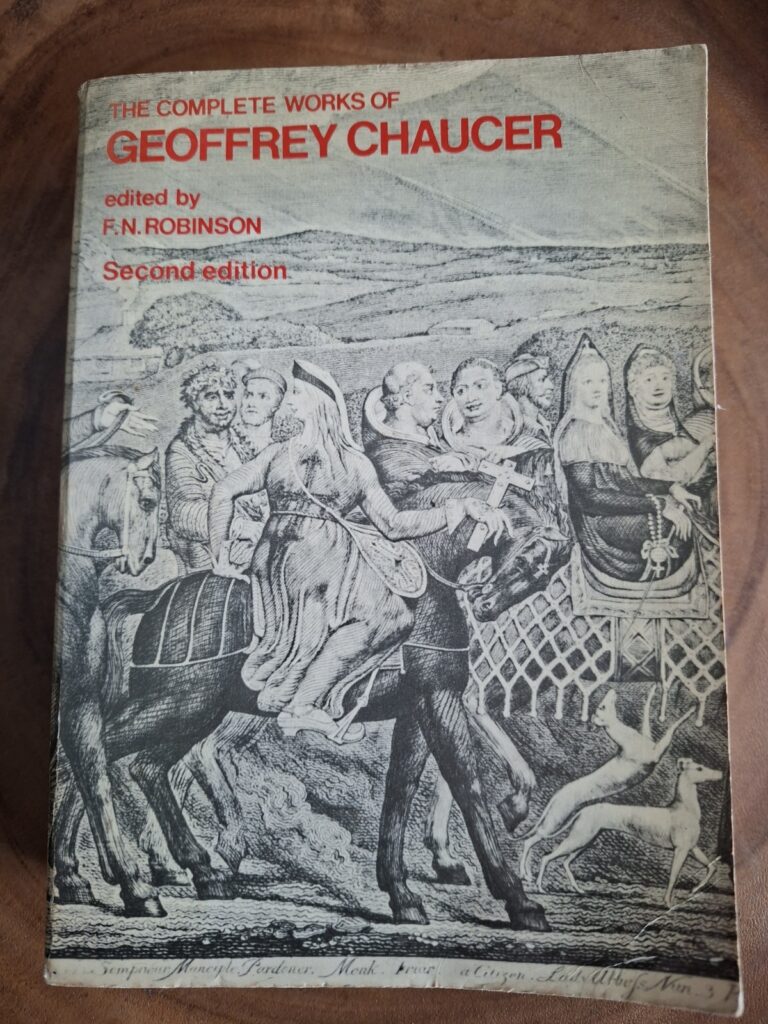
Our second year Middle English course had excluded anything by Chaucer, so it was no surprise to find that for those of us on scheme C, Chaucer was the entirety of our third year Middle English exposure. The main required text was the massive 1000+ page Robinson edition of the Complete Works, which was an Oxford paperback printed in double columns. Mine fell apart well before the end of the year.
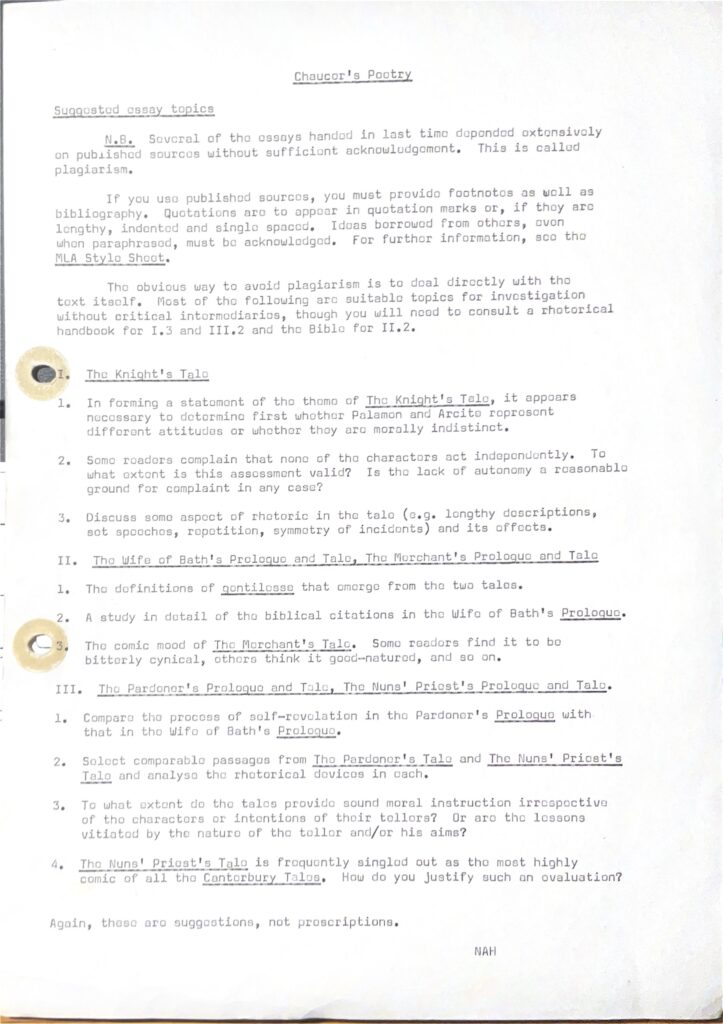
The course was directed by Betty Hill, about whom I wrote previously, and was constructed rather differently than the other courses we followed, most of which were a series of lectures on topics that we might or might not cover in the weekly tutorial. This was a more integrated course, with a lecture programme supported by seminars. The seminars were larger groups than the tutorials we were used to, comprising perhaps a dozen or fifteen students. As you can see from the handout, the course was extensive in its coverage:
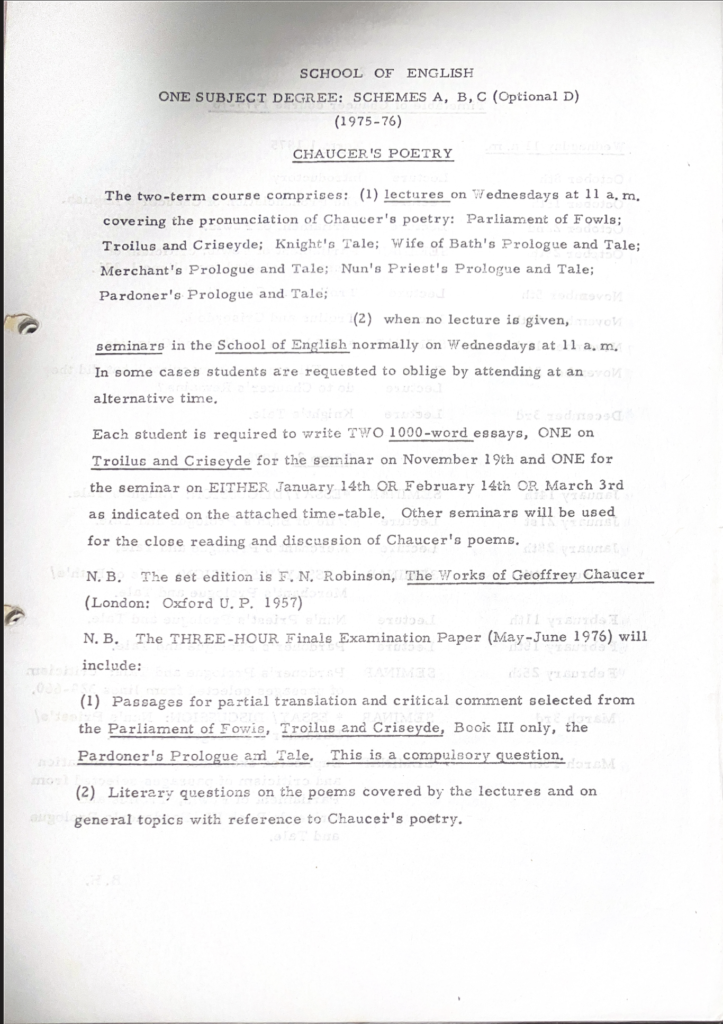
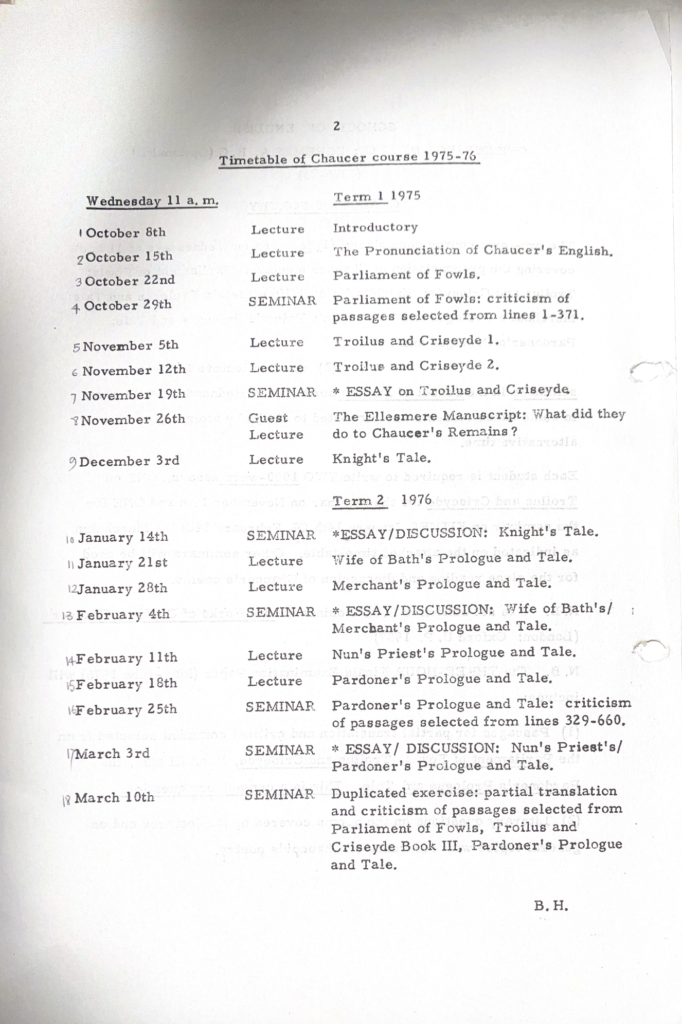
We were also given what Betty Hill described as a “select bibliography” consisting of 91 items, which seemed, shall we say, over-zealous. I had studied the General Prologue and several of the tales at school, so I felt reasonably well-prepared for this total immersion. Study was quite compressed: in one hour a week, over two terms, we had a huge amount to cover, but we managed. I must have known quite a bit about The Parliament of Fowls and Troilus and Criseyde by the end of the course, but trying to recall much about them know draws a blank. I can still recite bits of the General Prologue, though.
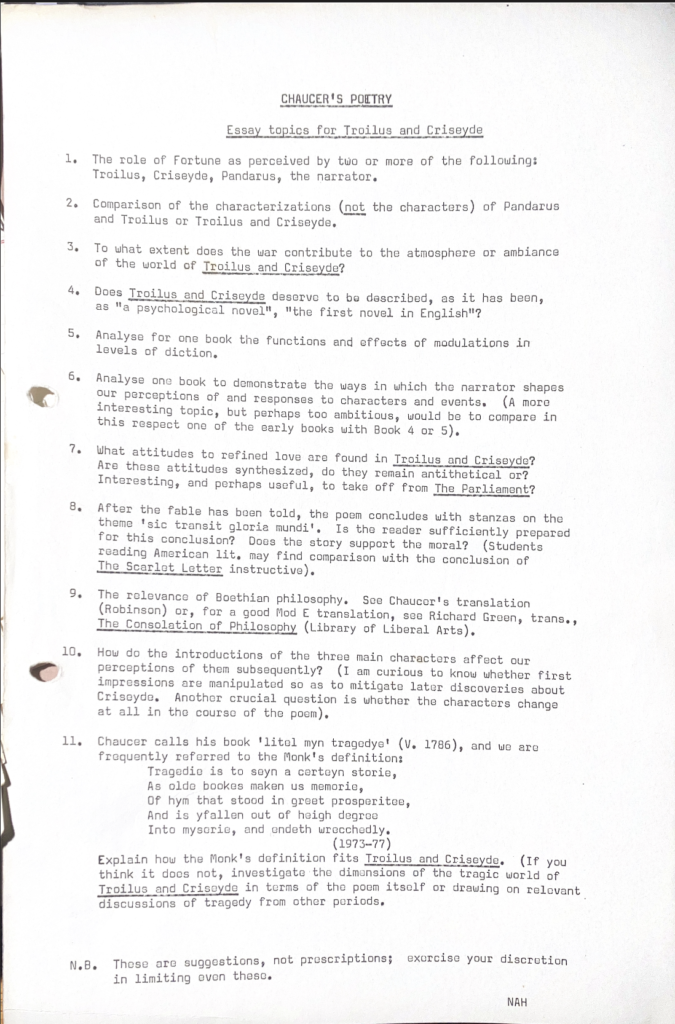
The essays we had to write were chosen from a very lengthy list, which we were encouraged to tailor to our own interests: again, a rather innovative touch. The essays were set by a tutor with the initials NAH, and to my shame, I can’t recall who that was. If any of my contemporaries are reading this, let me know. In the Autumn term, we wrote on Troilus and Criseyde. I’ve no evidence of which topic I wrote about. Not Boethian philosophy, I’m sure. Here’s the list:
The list of essay titles for the second submission had an interesting admonition about plagiarism. I think this is the first time I’d heard the word, certainly in the context of student essays. Whoever was plagiarising in 1976, they must have laboured long and hard, copying out by hand. I think this is also the first time I came across the concept of a style guide: up to this point, we had just been told to add a list of books consulted at the end of the essay, and of course to acknowledge any secondary quotations.
These were more innocent times. At the end of the course, we had had a pretty good grounding in Middle English to go along with our first-year exposure to Anglo-Saxon. Our tutors were world-leading experts, and we were barely out of our teens, and encountering so much that was new. This might account for the grumpy tone of Betty Hill’s memories of Leeds in her self-penned obituary. The specialists at Leeds were the leading lights of the Leeds Studies in English journal, which gathered contributions from all over the world, and acted as a showcase for the Institute for Medieval Studies, an inter-disciplinary centre, still at the heart of Leeds medieval scholarship today.
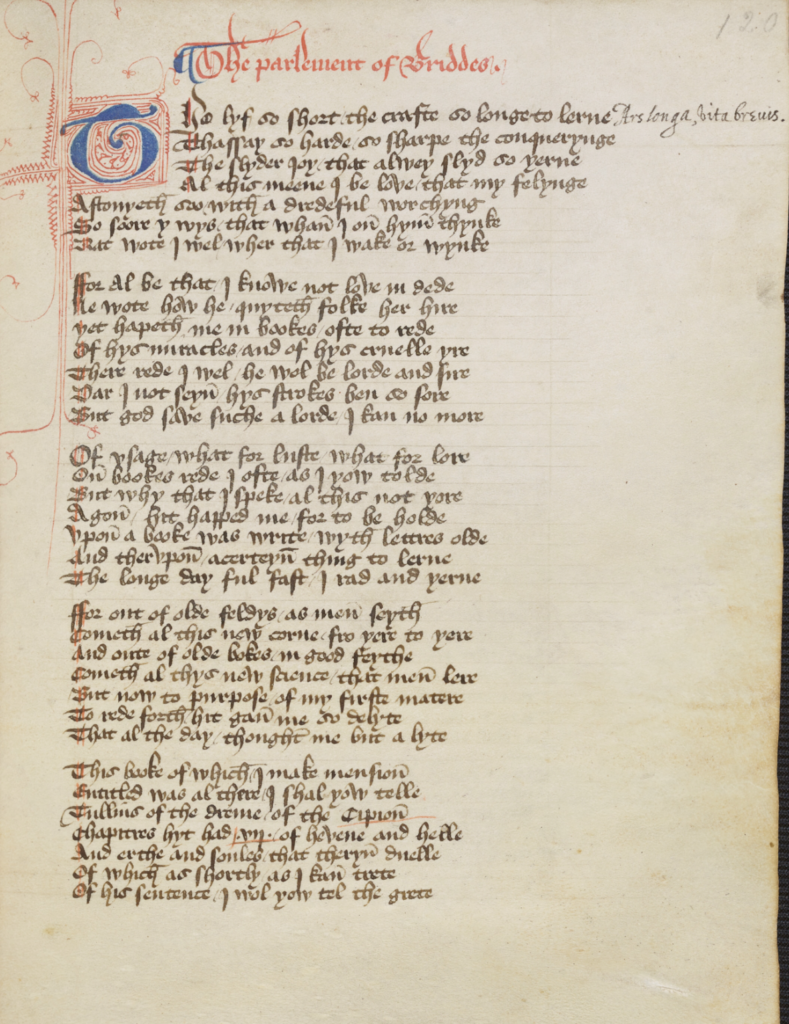
What did we learn from this? In my case, an abiding interest in the literature and culture of medieval Britain, and a few life lessons, not least the opening lines of The Parliament of Fowls:
The lyf so short, the craft so long to lerne,
Th’assay so hard, so sharp the conquerynge…
 Encounters with Chaucer by Dr Rob Spence is licensed under a Creative Commons Attribution-ShareAlike 4.0 International License.
Leave a Reply