Once again, the latest in this series is a Booker Prize winner by a woman novelist. Nadine Gordimer was the joint winner in 1974 with this novel set in her native South Africa. It was recommended to me fifty years ago when I was training as a teacher. Our tutor, the late great Douglas Barnes asked us what we were reading – it was probably some kind of ice-breaker exercise, I think – and his choice was this book. I’m ashamed to say none of us in the seminar had heard of it, though to be fair, I think the Booker was much less publicised in those days.
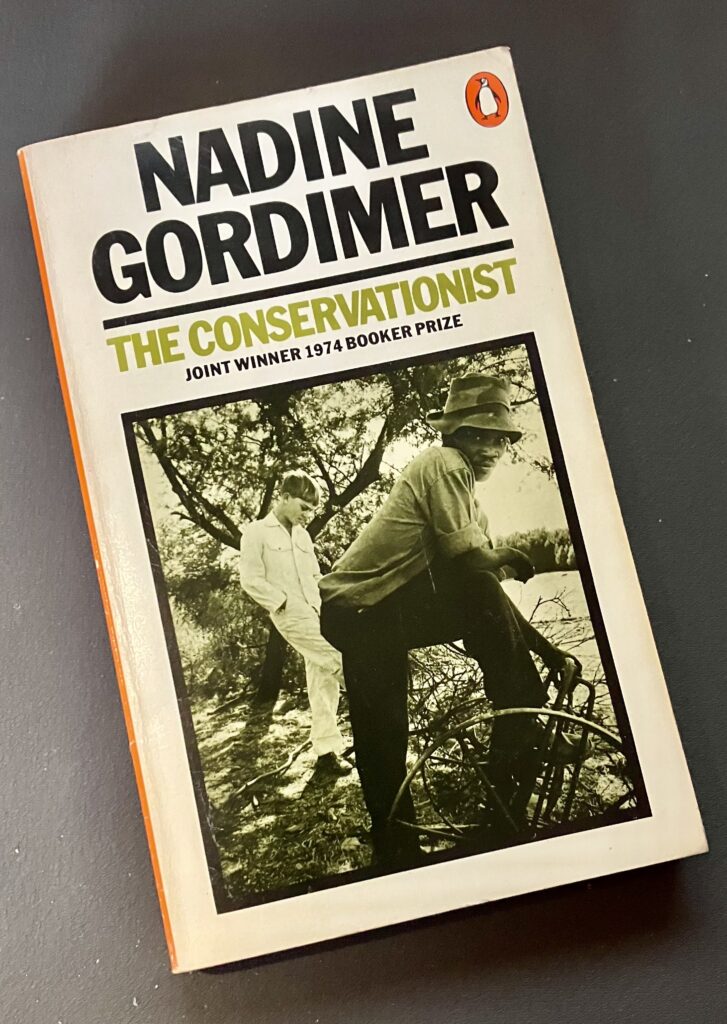
I remembered the recommendation, and bought the book, probably in 1978, since that’s the date on my edition. Almost half a century later, then, I’ve read it. And it’s strange to read this novel from today’s perspective. It takes place in the South Africa of apartheid, and features an archetypal man of the time, the prosperous white businessman Mehring. He has bought a run-down farm on the outskirts of the city – unnamed, but probably Johannesburg – and the novel presents a narrative in which he is forced to confront some of the issues that apartheid has produced.
Gordimer’s style is tricky: the narration is third person, sometimes in the present tense, sometimes not. But there’s a good deal of free indirect discourse too, which occasionally veers into Joycean stream-of-consciousness territory. Mehring, like a character from one of Browning’s monologues, reveals himself through his own thoughts and actions. Particularly in the final section, where Mehring’s rather irrational actions lead him into potential danger, the narrative become densely interwoven, Mehring’s moment-by-moment reactions being interspersed with the narrator’s sharply-drawn evocations of the landscape of the vlei. Here, for example, Mehring comes across a body that has been hastily buried on his farm:
Everything was sweet and fresh and beautiful, my God, lying there. The grasses nearly met overhead and moved under the weight of a body, gently feeling at it. The sun went behind a cloud and a cool palm of shadow rested a moment on cheeks warm from sleep; easy, always, to drop off down there after a late night or a long journey moving through emptiness, casting a rigid flying shadow over seas and forest and deserts without touch: never coming as close as the single silver-blond stalk that sinks and rises in the breeze to the ear or nose of the sleeper.—O Mehring, how you romanticize, how you’ve fallen for that place.—A stink to high heaven. It was not final; the only thing that is final is that he’s always there. It was never possible to be alone down there. Never lonely. Never feel lonely. It may sound crazy—No, put it another way. A funny thing—You don’t have to be a believer in a lot of superstition and nonsense—there’s a difference between thinking to oneself and thinking as a form of conversation, even if there are no answers.
Gordimer clearly uses Mehring as a symbol of white South Africa, and the body on the farm is indicative of the rotting political state of the country. The faultlines of apartheid are everywhere present: Mehring, a white businessman, divorced, promiscuous, misogynistic; his neighbours, the puritan Afrikaner de Beers; the black workers, some undocumented, who actually ensure that the farm works; the Indians who own the store supplying everything from clothing to sweets; and the vast unseen population of the shanty town, which is referred to just as “the location.”
Sam Jordison, writing a retrospective account of Booker winners in The Guardian , had this insight:
Gordimer’s book is cold, discomfiting and difficult for very good reasons. One of the most impressive and effective things about it is the growing sense of alienation one must feel to the world it presents and, specifically, its lead character. This is Mehring, a rich, white South African farmer. The sort of capitalist who imagines he has won his riches and privilege through hard work and ability rather than accidents of birth and injustice. A man with a self-righteous sense of his own worth coupled with a complete inability to understand the human cost of his own wealth. In a sense he is a hopeless figure, stumbling blindly and incomprehendingly through the world, especially on the farm he runs as a tax benefit and imagines as a kind of idyllic rural retreat, but where death, violence and collapse are ever present, just beneath the surface (quite literally in the case of a dead human body, buried early on in a shallow grave). In another sense, this wilful ignorance and arrogance gives Mehring his power and ability to excel, and sets the course towards tragedy – for everyone else.
It’s difficult to disagree. The Conservationist (the title is clearly ironic) is an uncomfortable read, and the reader needs to be attentive to shifts in tone and emphasis. Gordimer also uses quotations from the Victorian missionary Reverend Henry Callaway’s The Religious System of the Amazulu, which deals with the rituals and beliefs of the native South Africans in between chapters. They serve as further signs of the gulf between Mehring and the land he owns.
Reading this now, over thirty years since the election of Mandela as President of South Africa, ought to feel like reading a historical novel of a bygone age. But as a glance at any news feed from that part of the world will confirm, much of what Gordimer exposes in this novel still persists.
 Fifty Classics 5: The Conservationist by Dr Rob Spence is licensed under a Creative Commons Attribution-ShareAlike 4.0 International License.
Leave a Reply