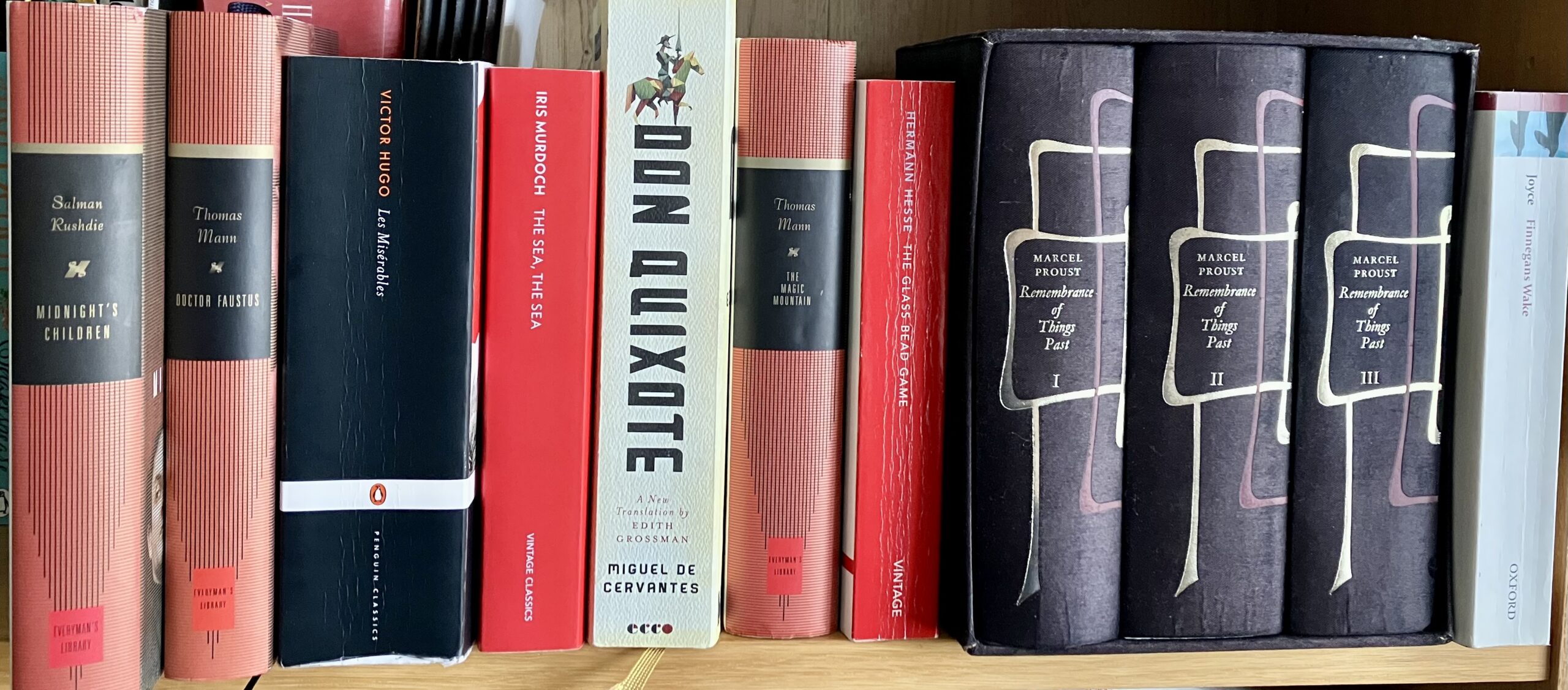
The Intercontinental Book Group. It sounds like the title of one of those whimsical novels, doesn’t it? The ones that often feature cats, coffee shops and libraries. Or those cosy feel-good stories, like The Guernsey Literary and Potato Peel Pie Society or The Mysterious Bakery on Rue de Paris. In fact, it’s the rather facetious name I gave to a group of friends who initially came together to read Finnegans Wake, which is not cosy at all. Back in 2014, I attended the annual James Joyce Conference in Utrecht. I was there under false pretences, really, as a member of a panel discussing the connections between Joyce and Anthony Burgess. In talking to my fellow Burgessians, it emerged that none of us had read Finnegans Wake. We felt this was a necessary challenge to overcome if we were to speak with any authority on Joyce, however tangential he might be to our Burgess studies. But since even the newly elected president of the Joyce Society had admitted he’d never completed the novel, we felt that some mutual support would be necessary. Thus was born, at the suggestion of our Belgian member, the idea of a joint reading, where we would cover a set number of pages each week, and meet via the wonders of internet telephony to discuss what we had read every Sunday.
We agreed on a diet of ten pages a week, to be discussed each Sunday at a mutually agreeable time, which would be in the evening for the UK and European members, and sometime in the morning for the US members. Ten pages didn’t seem like much, but if you know Finnegans Wake, you will know that it represents quite a daunting task. The Joyce Foundation in Zurich has been hosting reading groups for years, and continues to do so. But they manage a page per week, and my edition of Finnegans Wake runs to 630 pages, so…well, you do the maths. We convened the first online meeting in 2014, and soon established our house style. We were reading for pleasure, not for any academic purpose, and we were happy to go wherever the text took us, which, as you can imagine with Joyce, was all over the place. We found Joyce to be a remarkably prescient writer, making references to the Beatles or the Summer of Love decades in advance. At least, that’s how it seemed to us. We battled through, taking about eighteen months to finish the task. And when we finished it, we celebrated by meeting together at the Finnegans Wake pub in New York. The joint reading experience was by turns, exhilarating, exhausting, frustrating, illuminating, and genuinely life-enhancing. We didn’t take it too seriously, and we were happy to admit frequent bouts of baffled incomprehension. But we did read it all, and enjoyed sharing our impressions.
Having climbed that particular mountain, we were loath to give up the weekly ritual, so we agreed to continue, and came up with a few broad principles: we would read literary fiction, of considerable length (say 500+ pages) which none of us had read before. We decided that, given we were unlikely to tackle anything as demanding as Joyce’s masterwork again, we could manage perhaps 100 pages a week. Our habit since then has been to divide books up into roughly 100 page sections, making the divisions at convenient points in the book – the end of a chapter, usually. So a weekly assignment might be 85 pages, or 120 pages, but nearly always within those boundaries. Therefore, this was never going to be like those book groups that meet once to discuss a book and then move on to the next book. We were always going to spend at least four or five weeks looking at a novel in some detail. As it happened, our next novel took rather longer than a few weeks, because it was Proust’s A La Recherche du Temps Perdu. As with the Joyce, I don’t think I would ever have tackled this monumental work had it not been my duty to read it for the group. I am so pleased that I did: Proust has given me endless pleasure, both in the initial reading, and in subsequent reading of associated texts. One of the joys of our weekly discussion was comparing different translations with the original, which our Belgian was reading. Until then, I had never really explored the complexities of the act of translating , and indeed, had been rather snobbish about reading novels in translation. The Intercontinental Book Group cured me of that. I now have a Proust shelf with biographies and critical works alongside my edition of the magnum opus.
After a brief interlude where we read some Burgess novels together, because one or other of us were working on them at the time, we returned to our primary purpose with a reading of Don Quixote. How I had managed to reach that stage in my life without reading it, I don’t know. In teaching the early English novel, I would often confidently attribute some aspect or other to the influence of Cervantes, but doltishly, I had never gone to the actual source. What riches are there, especially in the superb translation we used, by Edith Grossmann. Since then, we have read some absolute classics, had one or two duds, and some surprises.
We have been relaxed about our initial rules, allowing some books that one of us had read before, and admitting a few under the 500 page mark. Because it’s all about enjoying reading, and each other’s thoughts. I can identify quite a few books that I don’t think I would have read without someone in the group proposing a joint reading: Hugo’s Les Misérables definitely falls into this category, as does Pynchon’s Gravity’s Rainbow. Currently, we just take it in turns to specify the next book; in the past we had some elaborate voting system, which wasn’t really effective. A recent review of our history made us realise that we had tended to favour male authors, so we deliberately chose women authors for a sequence of three reads, a trend I’d like to continue. I have a couple of suggestions which I’ll propose to my friends when the time comes. Among the thirty-something books we have read over the years, several really stand out. Thomas Mann’s The Magic Mountain is, almost literally, breathtaking; Middlemarch, which I first read fifty years ago, seems to me now to deserve its status as one of the great novels in English; A.S. Byatt’s Possession, a book I knew well, having taught it, revealed layer after layer of new meaning and depth on a re-reading; Demon Copperhead educated me about the state of America; No Name by Wilkie Collins proved just as gripping and enjoyable as any Dickens; and we have just completed my first Iris Murdoch. Meanwhile, we are about to embark on Lucy Ellmann’s Ducks, Newburyport, which clocks in at over 1000 pages. Since she is the daughter of Richard Ellmann, the distinguished biographer of Joyce, that brings us, by a commodius vicus of recirculation back to where we started.
The group, whose onlie begetter is Yves, currently comprises him in Belgium, Christine in Los Angeles, and me, usually, but not always in the UK. Chris, in Charlotte, North Carolina, is on long-term leave of absence to cope with the pressures of being a very active teacher, writer, and father of two young children. Our other founder member, our dear friend Alan, died some years ago. We miss him enormously, and we think of him every time we convene: I like to imagine his gentle, benign presence presiding over our continuing endeavours.
 The Intercontinental Book Group by Dr Rob Spence is licensed under a Creative Commons Attribution-ShareAlike 4.0 International License.
Leave a Reply