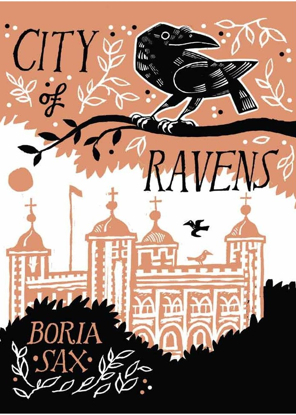
To Cromford, in the Peak district, largely to visit the excellent Scarthin Books, a rambling, old-fashioned second-hand bookshop, crammed with bibliographic treasure, and a very pleasant café to boot. Acting on instructions from ‘er indoors, and taking account of the overcrowded bookcases Chez Topsy, we emerged with just one book – City of Ravens by Boria Sax. This Sax cove is well-represented in the home library, since his books are usually about the representation of animals in literature, particularly European, an area of scholarly interest to she-who-must-be-obeyed. Isn’t Boria Sax a great name for a scholar? It exudes a kind of mittel-Europa or Bohemian sensibility, I think. I wonder if he is a relative of the inventor of what Homer Simpson calls the Saxomophone?
This little book is a fascinating account of the ways in which birds of the corvidae family are associated with omens, prophecies and other dark doings. Sax’s account of the legend of the ravens of the Tower of London, which forms a kind of centrepiece in this short book, is fascinating. I – and you, I suspect, dear reader – always assumed that the legend that England would fall if the ravens disappeared from the tower was one steeped in antiquity. Sax, however, puzzled that he could find no reference to the ravens in medieval or seventeenth-century literature, and maintaining a scholarly scepticism to the non-footnoted official guide, discovered that the birds were actually introduced in the late nineteenth century, and that the “legend” dates from as recently as the Second World War, when, in the Blitz, England might well have fallen.
This startling nugget is one of many in a volume that ranges from Anglo-Saxon to the present day, referring one moment to The Mabinogion and the next to James Joyce, by way of Harrison Ainsworth and Claude Lévi-Strauss. The book is academic, in that there is an extensive bibliography, and it is clearly a work of painstaking scholarship, but it is not dry; Sax is happy to add a personal touch, and to write in an accessible and sometimes humorous way. His career has not been that of a conventional academic, as his quirky website confirms, but his books on the area of animals in literature and mythology are authoritative. This lovely little book is a great addition to his canon.
Slack blogging around here of late, but I haven’t been completely idle. There was a blog for my Modernism students, which is still current, and available here. New posts to follow shortly.
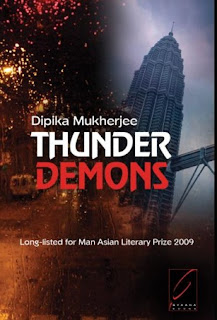
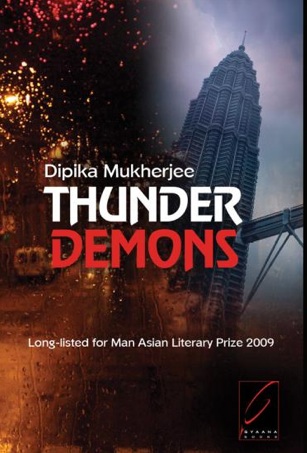
Back in November last year, my birthday weekend was spent in Amsterdam. We chose Amsterdam because we’d never been there, and because my friend Dipika Mukherjee was hosting the European launch of her novel Thunder Demons there. Dipika is professor of linguistics at Chicago and Shanghai universities, an affiliated Fellow at the International Institute of Asian Studies in the Netherlands, and also writes poetry and fiction. I suspect she doesn’t sleep.
Thunder Demons is a fast-paced thriller whose initial premise is based on an actual event, the mysterious murder of a Mongolian model in Malaysia. Although the work is clearly fiction, the use of a similar murder as the starting point for the action allows Dipika to explore the murky world of Malaysian politics in the context of a swiftly-unfolding story that centres on the intertwined lives of an airport worker, Agni, and an expatriate researcher, Jay Ghosh, who is returning to Malaysia at the prompting of the sinister Colonel S. Although the novel is set in contemporary Malaysia, and the action takes place over the course of a week, the plot delves back into Malaysia’s colonial past for some of its key details.
At one level, this is a love story, but at another it’s a discomforting examination of the state of the nation fifty-odd years after independence. Dipika, who is originally from India, and is married to a Malaysian national, writes tellingly about the tensions that lie beneath the surface of the “truly Asia” Malaysia of the tourist brochures. This is ultimately a dark, occasionally shocking story of political chicanery, casual brutality and racial tension. The thriller aspect makes it a page-turner, but the deeper themes remain long in the mind after the dramatic conclusion.
The novel isn’t available in the UK, but can be had from Amazon US and the usual online sites.

Yesterday was graduation day at Edge Hill for students in my department. It was great to see them all together, in their academic robes, and to be part of the ceremony. This year’s ceremony was different to most, in that we awarded an honorary degree to Mayer Hersh. As a survivor of Auschwitz, he would be remarkable by any standards. That he has dedicated the latter half of his life to educating people about the Holocaust, particularly through the Holocaust Educational Trust. makes him even more so. My colleague Prof Kevern Verney made the presentation, and Mr Hersh then made a very moving and and thought-provoking response, in which he recounted his experiences.The ceremony can be viewed here, and an interview is available here.
To be in his presence as he recounted how his life changed irrevocably when Germany invaded Poland the day after his thirteenth birthday, was a privilege. Many in the audience were moved to tears by his speech, at the end of which he received a standing ovation, something I’ve never witnessed at a graduation ceremony.
Too often, universities give honorary degrees to people because they are celebrities. In this case, we honoured a truly worthy figure, who, in the face of unimaginable cruelty, had dedicated his life to fighting prejudice. Never forget.
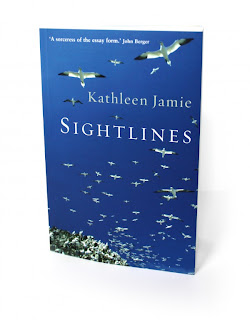
To the Burgess to see Kathleen Jamie talk about her new book of essays, Sightlines. I have long admired Jamie’s poetry, but in the essay form, I think she has found her true métier. The previous volume of short prose pieces, Findings, was a delight from start to finish: Sightlines is better. Both titles give a clue as to what is contained within – these are essays of observation and reflection, mostly, but not completely, of the natural world. What strikes the reader is the originality of the observations, particularly of the relatively mundane. She has a knack of seeing things from a startlingly original perspective, and she is able to communicate that vision in clear, sinuous language that delights and entertains.
The launch event was well-attended, and was set up, rather awkwardly I thought, as an interview with readings. Early on, though, Kathleen Jamie took control, and the questions became more like prompts for the next passage to be read. The scope of this, as with the previous volume, is wide. As well as the treatment of landscape, particularly of her native Scotland, the book chronicles Jamie’s investigation into the strange landscapes of cell biology seen through a hospital microscope, the Aurora Borealis, and the sight of a group of killer whales on the hunt.
She announced before the first reading that her journey to Greenland, detailed in the first essay in the book, was occasioned by a carpe diem realisation that she had reached middle age without seeing an iceberg. Her account of the journey takes in both the natural beauty of the land- and seascape, as well as the trials of a rough sea voyage. She reads with great clarity – not always the case when authors read their own work – and evokes the scenes she describes effortlessly.
The final reading was the dramatic account of the sight of killer whales off the coast of Rona, the island forty miles of the coast of Scotland, once inhabited, but now deserted, like St Kilda. In this essay, Jamie moves seamlessly from the ominous description of the whales’ arrival to the almost slapstick scene where the members of the groups she is with run around the headland chasing the whales as they hug the coastline below in search of prey.
The book is a delight, the photographs complementing the vivid writing. Each essay leaves the reader feeling that something has been illuminated in a rare and poetic way. This will sit on my shelf next to George Mackay Brown, than which I have no higher praise.
It’s already March, and I haven’t posted this year. I haven’t been completely in hibernation, though – in fact, I’ve quite a lot to report on, so I will start by offering some thoughts on a gig attended last night, and I’ll try to pick out some highlights from the last few months in subsequent posts.
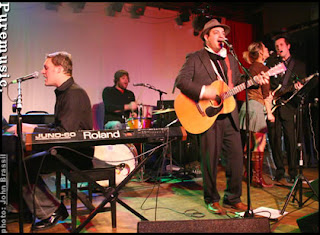
To the Ruby Lounge with ‘er indoors to see and hear Nashville’s Silver Seas. A Twitter comment by Danny Baker, whom God preserve, led me to check this group out, and their work has had, as they say, heavy rotation chez Topsyturvydom since. The line-up for this tour is the core members Daniel Tashian as the front man and guitarist and Jason Lehning on keyboards, with a rhythm section of the impressively bearded Lex Price on bass, and David Gehrke on drums. And they can play! In the awkward space of the Ruby lounge, they soon had a an audience of, shall we say, largely mature people bouncing around and singing out as they ran through a selection of songs mainly from the Chateau Revenge album.
The music is bright, intelligent pop. There’s nothing particularly demanding about it, but Tashian certainly knows how to construct a memorable song, with lyrics that are by turns urbane and wistful. The music is characterised by driving guitars, often ethereal keyboard sounds, and occasional Beach Boy-esque harmonies. The songs have melodies, hooks, and rarely last more than three minutes or so – perfect pop songs, in other words.
Half way through the gig, Tashian announced they had worked up a cover version, and launched into an upbeat rendition of Daydream Believer, accompanied lustily by the audience, in commemoration of the Mancunian Davy Jones. A perfect choice.
My friend Knappsterino often films at venues like this down in Bristol. I noticed several people doing just that, so doubtless the results will be up on YouTube soon. Meanwhile, someone posted a bit of Daydream Believer from the Glasgow gig:
Update: Here’s “Kid” from the Ruby Lounge gig, complete with irritating tossers talking through it:
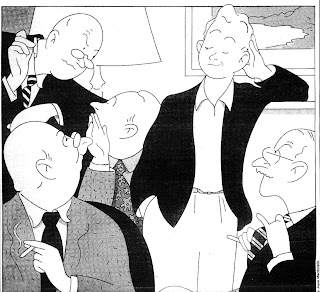
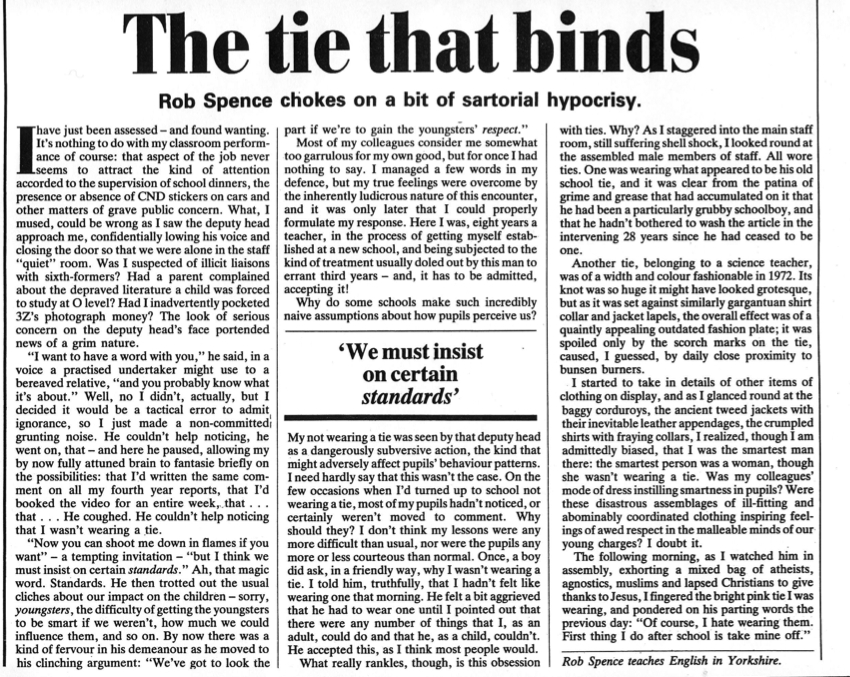
The first time I ever got paid for writing something was in 1985. I’d forgotten about it until yesterday when I found myself in a dusty corner of Manchester University library faced with a long shelf containing bound volumes of The Times Educational Supplement from the sixties to the nineties. I remembered writing a piece for them, and some of the aftermath. I knew it had printed in August, and I knew it must have been the mid-eighties, so it was easy to find. Hint to aspiring writers of educational stuff – pitch your article in July: they are desperate to fill the August columns. My piece was a lighthearted one about the tyranny (which seems even more in evidence now) of the tie as an essential item of the male teacher’s wardrobe. I never liked wearing them, and expressed my view in the article. I now wear ties for graduations and funerals, never for an ordinary day at work; but in a school, then as now, it was considered a major transgression not to wrap a piece of silk or polyester around your neck every day. So I wrote this:
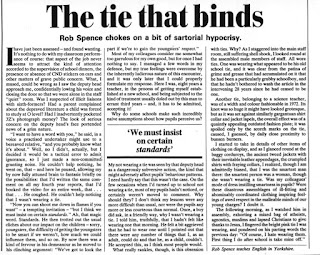
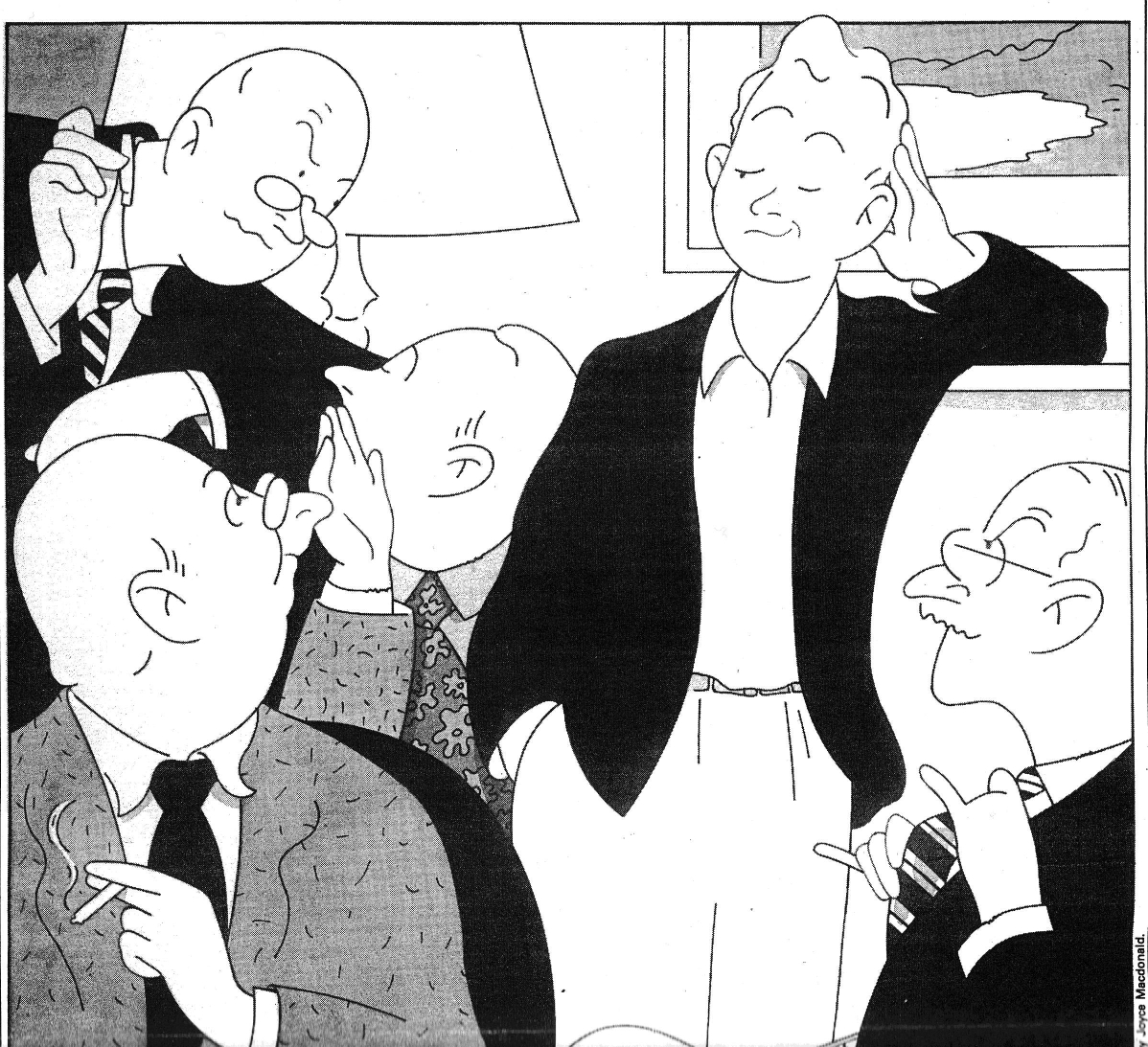
We were on holiday in France when the article was printed, and in those pre-mobile days, virtually uncontactable. About a week into the holiday, we found a working phone box and fed it with ten-franc pieces to speak to my father, just to report that we were having a great time. “Have you done something?” he said. “I’m sure I heard your name on the radio – something about an article..” I thought it must be the TES article, but didn’t think much more about it until we got home, to find requests from various newspapers for interviews. By then, the moment had passed, of course. This was classic silly-season stuff, but I gathered that for a couple of days the article had generated phone-ins on radio shows and some brief comments in newspapers. Probably the best part of the whole episode was the cartoon which accompanied the piece, reproduced above. I wish I could ever have looked that insouciant and elegant…
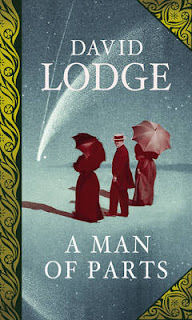
To the Whitworth, to see David Lodge talk about his new novel, based on the tangled love-life of H.G. Wells. I’ve admired Lodge for decades – Changing Places is one of the great comic novels, and certainly one of the top three examples of campus fiction ever written, I think. Lodge also wrote The Art of Fiction, one of the most sensible things available on that topic. Mostly, when authors are promoting their latest book, the routine is that the author reads a bit, and then answers some questions (often completely footling ones: “Where do you get your ideas from?”) before everyone queues to have their copy of the book signed. Lodge didn’t do this. Perhaps because he spent his working life as an academic, Lodge decided that the best thing to do was to give us a lecture on Wells. It was quite a formal one – he read, at a lectern, from a script, with very few ad-libs, in a style I imagine Birmingham Eng Lit undergraduates would have recognised. It was, nonetheless, an enlightening and engaging talk, ranging over Wells’s incredibly productive career, and making a strong claim for a revaluation of his reputation. At one point, Lodge recounted how the elderly Wells refused to move out of London during the blitz, declaring that he would not be beaten by “that shit, Hitler”. and that he took his turn firewatching in a tin hat. Wells presciently saw how aircraft would be used in future wars, and also posited the development of something very like the WWW – the World Brain, which would keep all human knowledge on microfiche. Lodge, whose hearing is weak, was supported by an energetic assistant signing his words. He then did the readings and answered questions, which for once were pertinent and intelligent – and no, I didn’t ask any. One point which he spoke about at length was the emergence of what he called the “bio-novel”, the fictional work based on the life of a real person. A Man of Parts is one such of course, as is Lodge’s Author Author, based on the life of Henry James. Julian Barnes’s Arthur and George would be another example. That seems to me to be an interesting line of research – I’m just wondering what other novels fit this category. Lodge said that his rule was not to make anything up except the dialogue and the extradiegetic narrative. As he said, that solves a basic problem, since the plot is already there. Rather than tell the whole life story, he comcentrated on the central years of HG’s life, when he was extraordinarily entangled with a series of women.
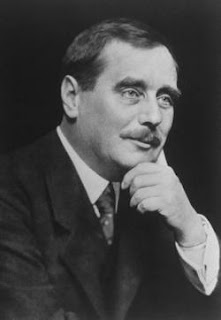
What was so attractive to women about Wells? He was short, physically weak, and hardly a pin-up. But he was full of energy, full of ideas, and compelling as a speaker. That seemed to do the trick. His narrative gift, allied with his knowledge of science, makes his work unusual, and, according to Lodge, ripe for rediscovery. Of course. Lodge’s book will obviously aid that process. At the end of his life, according to Lodge, Wells was working simultaneously on two factual pieces, one which despaired of mankind ever evolving into something nobler, and one which predicted a utopian future. I wonder what he would make of us now?

To the place everyone now calls the Burgess for a Manchester Literature Festival event with Roma Tearne. She was reading from her most-recently published novel, The Swimmer, and talking about her career, her novels, her other activities as an artist and film-maker, and, inevitably, about her views on Sri Lanka. She left her native country for Britain in 1964, and has made her life here ever since. Sadly, when someone asked her if she ever planned to go back to Sri Lanka, she replied that it was impossible, given the death threats she has received as an outspoken opponent of the regime.
Most writers, because they are writers and not performers, don’t read their work particularly well. Roma is an exception. She read a passage from The Swimmer beautifully, bringing a poignancy that was palpable to a scene of great sadness. She answered questions with great good humour, and revealed a good deal about her working methods. One particularly striking aspect was her revelation that she always starts with an image. In the case of The Swimmer it was a photograph of a windswept Aldeburgh beach on which three figures were walking. She imagined the story of these three characters, and the novel grew from there. Several members of the audience commented on the power of her landscape scenes, and one questioner asked whether she painted landscapes – yes, she does. The evocative atmosphere of the East Anglian coast, with its melancholy emptiness, and sense of liminality, seems an appropriate setting for this tale.
What’s more, she has used one aspect of The Swimmer to inform the film that she made for the Venice Biennale. The novel, which features a plot about a Sri Lankan immigrant, is used to complement the horrific footage of brutal attacks by the Sri Lankan army on the Tamils during the civil war. The found footage is intercut with the new film, shot on iPhone to merge with the raw images of the massacre.
It was a privilege to have a short conversation with her after the event, and now I must get down to reading the novels, starting with the semi-autobiographical Brixton Beach.

I’ve posted before about the fatuous and often bizarre language used by companies to describe what they do. The slogans and mission statements often use ‘solutions’ as a catch-all term, and tend to pomposity when describing the most mundane matters. I observed a cracker today, on a van belonging to a company I hadn’t heard of before: ProLicht, with the trendy inter-capital. Their business, according to the statement on the van, is “turnkey solutions for national and international corporate brand programmes.” No, I had no idea, either. So I looked them up. As you might expect from the name, they are a German company, and their business is making signs. So, “turnkey solutions for national and international corporate brand programmes” means “signage”. Their website is a treasure trove of corporate bollocks-speak, often using those incomplete sentences. You know. Like this. To seem more important. Or something.
They clearly don’t think it’s necessary to tell us what a turnkey solution is, so I checked with Wisegeek (much plagiarised by students, I note in passing) where I am told that a turnkey solution is “a solution that can easily be implemented based on the resources already at the disposal of a company or individual.” I’m not sure that gets me much further, but maybe it means that ProLicht will make you some signs that you can afford. I’m not sure, and the language of the website doesn’t enlighten me further. For example – “Our customers are happy to work with us. We see this in the fact that they are doing so more and more intensively. Every year, they develop their cooperation with us on an ongoing basis.” I’m assuming that, as a customer, developing my co-operation with them on an ongoing basis means I use them more than once. Obviously, the fact that “The entire process chain within view ensures the best quality” will make me want to use them again. It would, I’m sure, be enlightening to meet them. After all, “We would be happy to present in a personal meeting our company, our mindset, our approach, our diverse references and why our customers continuously extend their cooperation with us.”